The scariest thing about nicotine withdrawal is not any single symptom. It is not knowing what is coming, or whether what you are feeling is normal, or when it ends. On day two, the irritability feels like a personality change. On day four, the insomnia and the fog make you wonder if you have broken something. And because nobody handed you a map, every symptom arrives with the same anxious question attached: is this supposed to happen?
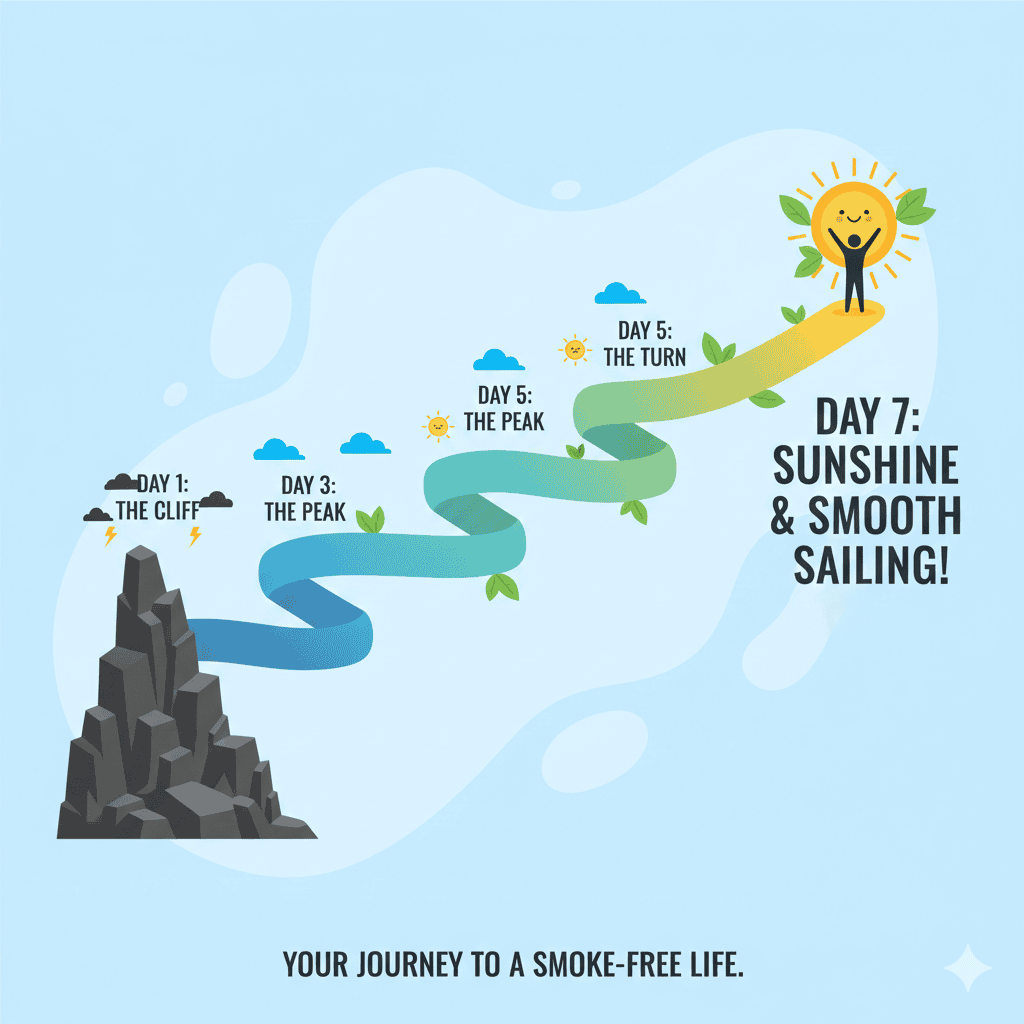
Yes. All of it. Nicotine withdrawal is one of the best-documented processes in addiction medicine, and it follows a remarkably consistent arc: onset within hours, a peak around days 3 to 5, and a steady fade over 2 to 4 weeks. This is the map: what happens hour by hour and week by week, what each symptom means, and what actually shortens the miserable part.
Why Withdrawal Happens at All
Nicotine works by binding to acetylcholine receptors in the brain and triggering dopamine release, dozens of times a day, for years. The brain adapts the way brains always do: it grows extra nicotinic receptors (a pack-a-day habit roughly doubles them) and dials down its own baseline dopamine signaling, because the drug keeps supplying the stimulation externally.
Quit, and the arrangement collapses overnight. Nicotine has a half-life of about two hours, so within a day the drug is essentially gone, and by 72 hours it has cleared completely (though tests can detect its metabolites longer). What remains is a brain with double the receptors, all of them empty and signaling for the input they were built around, and a reward system running below its natural baseline until it recalibrates. Every withdrawal symptom on the list below is a downstream effect of that recalibration, which is also why every one of them is temporary: receptor numbers renormalize over roughly 4 to 12 weeks, and the symptoms fade on the same schedule.
The Timeline: Hour by Hour, Day by Day
Individual curves vary with how much and how long you smoked, but the shape is consistent across withdrawal research.
Hours 4 to 24. Onset. As blood nicotine falls, the first cravings arrive, along with restlessness and irritability. Many people also notice they are hungrier by evening. Meanwhile the body has already started repairing: heart rate and blood pressure drop toward normal within hours, and carbon monoxide clears from the blood by the end of day one.
Days 1 to 3. The climb. Cravings sharpen and come more often. Anxiety and irritability build, concentration starts to slip, and headaches often appear as blood vessels and oxygen levels adjust. By hour 72, nicotine is fully out of the body. This is the moment of peak receptor emptiness, and it marks the entrance to the hardest stretch.
Days 3 to 5. The peak. This window is the documented worst of the entire quit, and it is worth knowing that in advance, because from inside it the intensity feels permanent. Cravings hit maximum frequency, sleep fragments just as the vivid dreams start, the brain fog thickens, and mood bottoms out. None of it means anything is wrong. It means the recalibration is at full throttle, and it is the top of the curve: from here, every day trends easier.
Week 2. The turn. Physical symptoms fade noticeably. Sleep starts consolidating, headaches taper off, and cravings space out from a constant background pull to distinct, survivable waves. Many people are surprised by a wave of fatigue in this window as the body works out how to run on its own stimulation, without the forty daily hits it was built around.
Weeks 3 to 4. The fade. Most physical withdrawal is over or nearly over. Concentration measurably recovers, mood climbs back through baseline, and appetite starts settling. What remains is mostly psychological: the habit loops, the trigger moments, the hand that reaches for a pocket that no longer matters. Our first week guide and 30-day milestone piece cover these two phases in day-level detail.
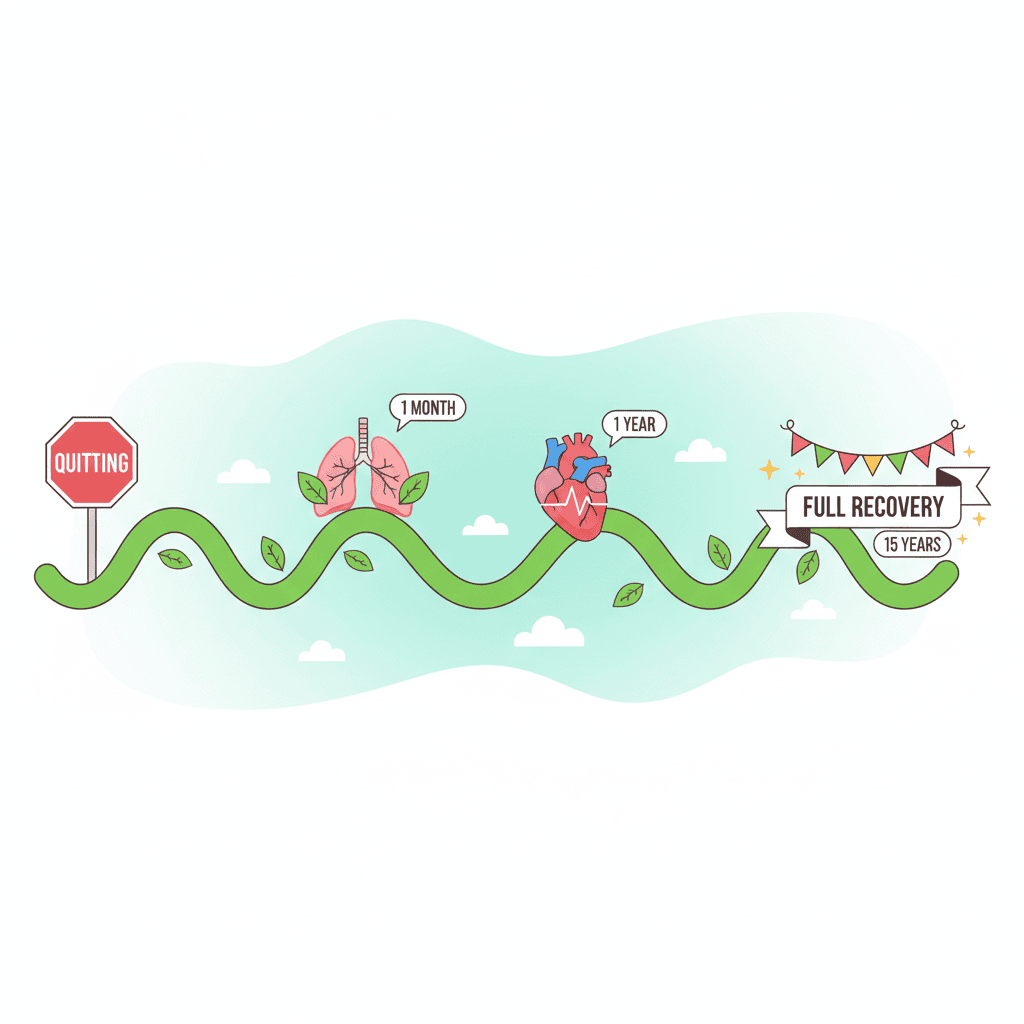
Months 2 and beyond. The echoes. Acute withdrawal is done, but conditioned cravings persist: a stressful meeting, a beer, a coffee, an old smoking corner can each fire a sudden, vivid urge months later. These are not returning withdrawal. They are 3-to-5-minute conditioned responses, they weaken every time you outlast one, and their long-term timeline has a map of its own.
The Symptoms, One by One
Cravings. The signature symptom: sudden, intense urges that peak in the first 72 hours and arrive as waves, not a steady state. Each wave crests and passes in about 3 to 5 minutes whether or not you smoke. The full playbook for riding them out is in our craving management guide.
Irritability and anger. The most socially expensive symptom. With dopamine signaling below baseline, your frustration tolerance drops through the floor for roughly two weeks. Warning the people around you in advance genuinely helps, and it is not a character change: it is chemistry, and it reverses.
Anxiety and restlessness. Withdrawal anxiety typically peaks in the first week and then drops, and here is the part worth holding onto: studies consistently find ex-smokers end up less anxious than they were while smoking, once the transition ends. The full anxiety timeline explains why the spike is a passing phase, not a preview.
Low mood. Quitting removes forty small dopamine hits a day, and the gap registers as flatness or sadness for a couple of weeks while the system renormalizes. A low mood that deepens or persists beyond a month is different: that deserves a clinician, not more willpower.
Insomnia and vivid dreams. Sleep fragments in week one as REM rebound repays years of nicotine-suppressed dreaming, usually with strikingly cinematic dreams, sometimes about smoking itself. It resolves within 2 to 3 weeks, and there are specific fixes that speed it up, starting with your coffee.
Brain fog and poor concentration. Attention and working memory dip measurably in the first two weeks because the brain used nicotine's acetylcholine boost as a cognitive crutch. It clears on a known schedule, and the cognition you get back is better than the one you borrowed.
Headaches. Common in the first week as circulation, oxygen levels, and blood vessels readjust, and often amplified by a hidden mechanism: quitting doubles caffeine's effective dose, because smoking was burning through your coffee twice as fast. The headache guide covers the fixes.
Hunger and weight. Appetite rises for several weeks: nicotine was suppressing it and blunting your insulin response, and taste buds recovering makes food genuinely better. Expect a real but manageable appetite shift, lean on foods that blunt cravings, and know the average weight change is smaller than feared.
Cough and sore throat. Counterintuitively, a cough often gets worse in weeks 1 to 4. That is the airways' cilia coming back online and sweeping out years of accumulated tar, a healing sign, not a warning.
Constipation and digestive upset. The least discussed symptom: nicotine stimulated gut motility, and its absence slows digestion for a few weeks in up to one in six quitters. Water, fiber, and movement cover it.
What Actually Softens the Curve
Withdrawal is self-limiting, so everything below is about lowering the peak rather than waiting it out longer.
Nicotine replacement and medications. Properly dosed NRT roughly halves withdrawal intensity by tapering the receptor system down gradually instead of dropping it off a cliff, and combination NRT (patch plus gum or lozenge) works better than either alone. Prescription options varenicline and bupropion target the same receptors chemically, and nicotine pouches occupy a messier middle ground worth understanding before you lean on them.
Cut your caffeine in half. The single least-known high-leverage fix. Your usual intake now acts like double the dose, which quietly amplifies the anxiety, restlessness, headaches, and insomnia you are attributing entirely to withdrawal.
Move, daily. Even a brisk 10-minute walk measurably blunts craving intensity for up to an hour, and regular exercise improves mood, sleep, and the weight curve simultaneously. It is the closest thing withdrawal has to a universal remedy.
Breathe through the waves. A craving wave lasts 3 to 5 minutes, and slow paced breathing at around six breaths a minute is the most portable way to ride one out: it shifts the nervous system from fight-or-flight toward rest in about two minutes, exactly the window a wave needs to crest and pass. We built Flow Breath for precisely these moments: a few minutes of guided breathing, no decisions required, as many times a day as the waves come.
Do not re-dose "just once." One cigarette in week two does not just cost the streak. It re-sensitizes the receptors and re-runs several days of the curve you already paid for. If a slip happens anyway, it is recoverable, but the physiology is the reason to treat "just one" as expensive rather than harmless.
When It Is More Than Withdrawal
Withdrawal is loud but benign, and it follows the shape above: onset in days, peak in the first week, clear improvement by weeks 2 to 3. See a clinician if the pattern breaks: low mood that deepens past two to four weeks or brings hopelessness with it, anxiety that escalates instead of fading, chest pain (never file that under withdrawal), or a cough that is still worsening after a month or produces blood. And if you take chronic medication, tell your prescriber you quit: smoking sped up the clearance of several common drugs, and your effective dose may have just risen.
How Smoke Tracker Turns the Timeline Into a Tool
The whole point of a withdrawal map is knowing where you are on it, and that is what a tracker makes concrete.
- Streak Counter: On day four, the single most useful fact is that day four is the peak. Seeing exactly where you stand on the curve reframes the worst stretch as a position, not a permanent state.
- Health Timeline: While withdrawal is loud, recovery is silent. Watching heart rate, circulation, and lung milestones tick past during the exact window the symptoms scream keeps both stories in view at once.
- Craving Log: Log each wave and its trigger for one week and the pattern almost always points somewhere specific: the coffee, the drive, the after-lunch slump. A named trigger is a manageable trigger.
- Money Saved: Withdrawal has a cost; so did smoking. Watching the savings number climb through the hardest week is the most concrete possible reminder that the discomfort is buying something.
Nicotine withdrawal is not an open-ended ordeal. It is a curve with a known shape: up for three days, brutal for two, easing for two weeks, and gone within a month, with only fading echoes after that. Every symptom on the list is your brain rebuilding a signaling system it once outsourced to a drug, and every day on the curve is a day you never have to repeat, unless you re-dose and rewind it.
The worst 72 hours of your quit are also the only 72 hours like them. Know the map, soften the peak, and let the curve do what it always does: end.
Sources
- Hughes, J. R. (2007). "Effects of abstinence from tobacco: valid symptoms and time course." Nicotine & Tobacco Research. pubmed.ncbi.nlm.nih.gov
- U.S. Department of Health and Human Services. (2020). "Smoking Cessation: A Report of the Surgeon General." cdc.gov
- National Cancer Institute (smokefree.gov). "Managing Withdrawal." smokefree.gov
- Cosgrove, K. P., et al. (2009). "β2-Nicotinic acetylcholine receptor availability during acute and prolonged abstinence from tobacco smoking." Archives of General Psychiatry. pubmed.ncbi.nlm.nih.gov
- Hartmann-Boyce, J., et al. (2018). "Nicotine replacement therapy versus control for smoking cessation." Cochrane Database of Systematic Reviews. pubmed.ncbi.nlm.nih.gov
- Lindson, N., et al. (2019). "Different doses, durations and modes of delivery of nicotine replacement therapy for smoking cessation." Cochrane Database of Systematic Reviews. pubmed.ncbi.nlm.nih.gov
- Taylor, A. H., et al. (2007). "The acute effects of exercise on cigarette cravings, withdrawal symptoms, affect and smoking behaviour: a systematic review." Addiction. pubmed.ncbi.nlm.nih.gov
- Taylor, G., et al. (2014). "Change in mental health after smoking cessation: systematic review and meta-analysis." BMJ. pubmed.ncbi.nlm.nih.gov
- Faber, M. S. and Fuhr, U. (2004). "Time response of cytochrome P450 1A2 activity on cessation of heavy smoking." Clinical Pharmacology and Therapeutics. pubmed.ncbi.nlm.nih.gov
- NHS. "Stop smoking treatments and withdrawal symptoms." nhs.uk
Common questions
- How long does nicotine withdrawal last?
- The acute phase lasts 2 to 4 weeks for most people. Symptoms start within 4 to 24 hours of the last cigarette, peak around days 3 to 5, and decline steadily from week 2 onward. By the end of week 4, most physical symptoms (headaches, fatigue, increased appetite, sleep disruption) have resolved or nearly resolved. What lingers longer is psychological: situational cravings tied to triggers like coffee, alcohol, stress, or driving can resurface for months, but they arrive as brief 3-to-5-minute waves rather than the constant background pull of the first week. Heavier, longer-term smokers tend to sit at the longer end of the range, lighter smokers at the shorter end.
- What are the worst days of nicotine withdrawal?
- Days 3 to 5 are consistently the hardest stretch in withdrawal research. By around hour 72, nicotine and its main metabolite cotinine have fully cleared the body, and the brain's roughly doubled population of nicotinic receptors is empty and signaling loudly. That is when cravings hit peak frequency and intensity, and when the secondary symptoms (insomnia, irritability, anxiety, brain fog, headaches) all overlap at their maximum. Knowing this in advance matters, because at day four the intensity feels permanent, and it is actually the top of the curve: people who get through day 5 have passed the physiological worst of the entire quit.
- What are the symptoms of nicotine withdrawal?
- The core cluster: intense cigarette cravings, irritability and restlessness, anxiety, low or depressed mood, trouble concentrating (brain fog), insomnia and unusually vivid dreams, headaches, fatigue, increased appetite with a shifted preference toward sweets, constipation, and a cough that can temporarily get worse as the airways' cleaning system restarts. Dizziness and tingling in the hands and feet can appear in the first days as circulation and oxygen levels improve. Not everyone gets every symptom, and intensity varies widely with smoking history. All of them are temporary, and none of them are medically dangerous, though a persistent low mood beyond a few weeks deserves a clinician's attention rather than willpower.
- Does everyone get nicotine withdrawal symptoms?
- No. Severity tracks roughly with nicotine dependence: how much you smoked, for how long, and how soon after waking you needed the first cigarette. Light or intermittent smokers sometimes quit with little more than a few days of restlessness, while a pack-a-day smoker of twenty years usually gets the full curve. Genetics also play a role in how quickly people metabolize nicotine and how their reward system adapts. But mild withdrawal is not a sign the quit is not working, and severe withdrawal is not a sign something is wrong. Both are normal, both peak in the same day 3 to 5 window, and both resolve on the same rough timeline.
- Can nicotine withdrawal symptoms come back after a few weeks?
- The physiological withdrawal does not restart on its own, but two things can feel like a relapse of symptoms. First, situational cravings: long after the acute phase, a strong trigger (a stressful day, a drink, a coffee, an old smoking spot) can fire a sudden, vivid urge. These are conditioned responses, not returning withdrawal, and they pass in a few minutes. Second, any nicotine re-exposure, even one cigarette or a few puffs, re-sensitizes the receptor system and can genuinely reboot several days of withdrawal-like symptoms. That is the practical reason the 'just one' cigarette is so costly: it does not just risk the streak, it re-runs the hardest part of the curve.
This article is for informational purposes only and does not constitute medical advice. Health information is based on published research from organizations such as the CDC, WHO, and American Lung Association. Always consult a healthcare professional for personalized guidance on smoking cessation.