You are three days in and the hunger is relentless. Not the polite kind that shows up at mealtimes, but a low, constant pull toward the kitchen that does not switch off even an hour after you ate. You finish dinner and want a snack. You stand in front of the fridge with the door open and no real plan. The story most people tell themselves at this point is that quitting has flipped some permanent switch and turned them into a bottomless pit. That story is wrong in an important way. Most of what you are feeling is temporary, a good chunk of it is not actually hunger at all, and the part that is real is far smaller than it feels in the first chaotic week. Here is what is happening to your appetite after your last cigarette, when it settles, and how to tell the hunger that wants food from the craving that just wants a cigarette.
Why Quitting Spikes Your Appetite
The early-quit hunger is not one thing. It is several mechanisms firing together, which is why it feels so total and so unlike ordinary appetite.
The first and most direct is the removal of nicotine's appetite brake. Nicotine is a genuine appetite suppressant. It acts on receptors in the hypothalamus, the brain region that governs hunger and fullness, in a way that dampens the drive to eat. It also raises resting metabolic rate by roughly 5 to 10 percent, so smokers burn slightly more energy and feel slightly less hungry around the clock. When you quit, both effects disappear within days. The brake comes off, and the appetite you feel is, in part, simply the true appetite that nicotine was masking the whole time.
The second is the dopamine reward swap. Smoking flooded your reward system with dopamine on a tight, reliable schedule. When that supply stops, the reward system enters a temporary trough and starts hunting for any quick hit to fill the gap. Food, especially sweet and fatty food, is the fastest and most available dopamine source there is. This is why the early-quit hunger so often points at chocolate, chips, and sugar rather than at a balanced plate. It is not your stomach asking. It is your reward system substituting one quick reward for the one it lost. The same trough is at work across the early weeks, and we map it in detail in our guide to the dopamine reset after quitting.
The third is the oral-fixation transfer. A pack-a-day smoker performs the hand-to-mouth motion of smoking around 200 times a day for years. That ritual is deeply wired, and when the cigarette disappears the hand keeps reaching for the mouth. The nearest acceptable substitute is food. Much of the constant snacking in the first weeks is the body running an old motor program with a new object, not responding to real energy need.
The fourth is blood sugar instability. Nicotine influences how the body releases glucose and insulin, and in the first days without it, blood sugar can swing more than usual. The dips read as sudden, urgent hunger, often for fast carbohydrates, and they can hit hard between meals before the system steadies.
Layered over all of this is the sensory change. Within 48 to 72 hours of your last cigarette, taste and smell start coming back, and within a week food is sharper, richer, and more appealing than it has been in years. Food that was flat and forgettable while you smoked is suddenly worth seeking out. Our piece on how taste and smell return after quitting covers exactly why this happens and why it makes the fridge so much more interesting in week one.
Hunger or Head Hunger: How to Tell Them Apart
This is the single most useful distinction in this whole topic, because a large share of early-quit "hunger" is really nicotine craving wearing a food mask. The two feel similar in the moment but behave completely differently, and learning to tell them apart removes most of the unnecessary eating.
True hunger builds gradually over a couple of hours. It is felt in the stomach, sometimes as emptiness or a quiet growl. It is non-specific, meaning you would happily eat something plain like an egg or an apple. It eases after you eat and then stays gone for a while.
Head hunger, the craving in disguise, behaves the opposite way. It appears suddenly, often the moment after a trigger like finishing coffee, a stressful email, or stepping outside. It is felt in the mouth or the mind rather than the stomach. It is specific and insistent, demanding a particular texture or a sweet hit, and a plain food will not satisfy it. And it passes within a few minutes whether or not you eat, which is the tell. Real hunger waits for food. Head hunger waits out the clock.
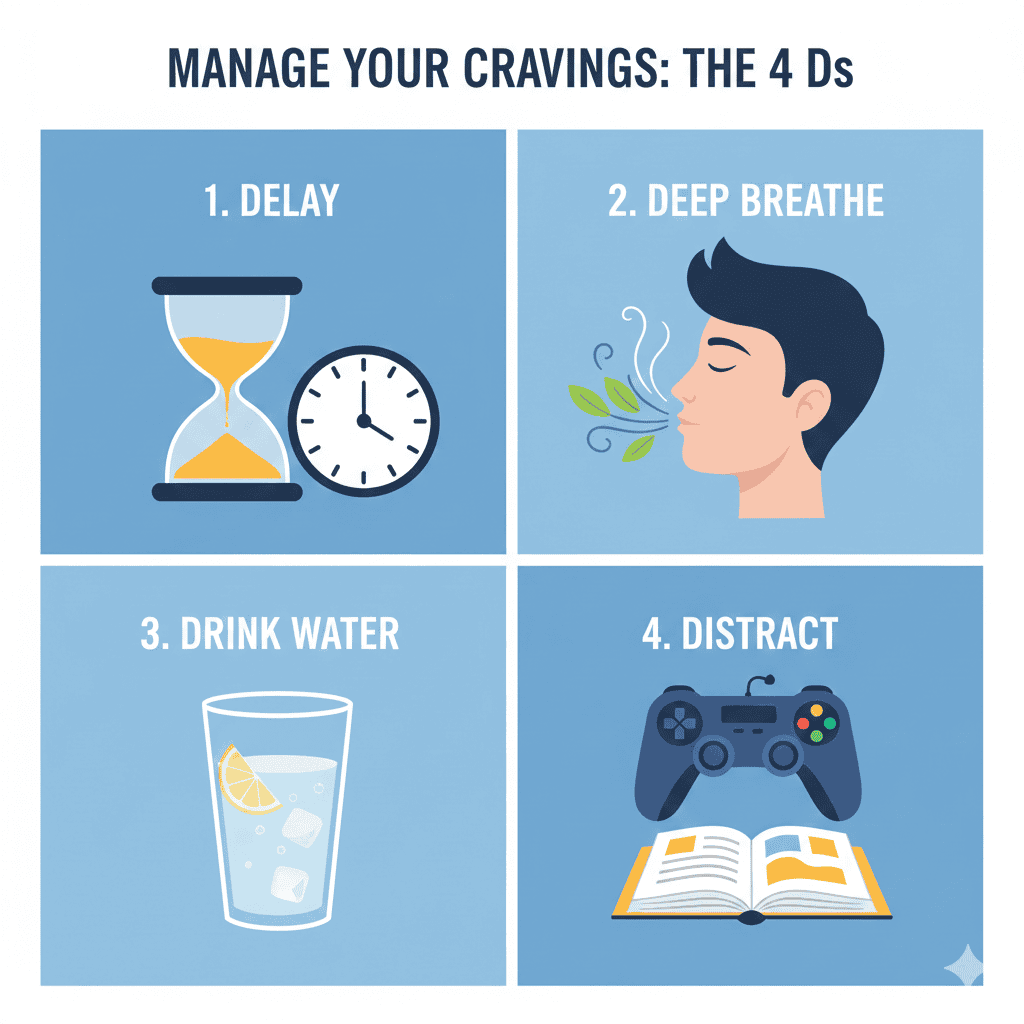
The simplest field test is water and time. When the urge hits, drink a full glass of water and wait five minutes. If it fades, it was craving, not hunger. If it is still there and you would genuinely eat something plain, it was real. The mechanics of riding out that five-minute window are the same skill as riding out any nicotine craving, which we break down in our guide to managing nicotine cravings.
The Appetite Timeline After Quitting
Individual variation is large, but the shape is consistent across nicotine-withdrawal research.
Days 1 to 3. Onset. Nicotine clears, the appetite brake lifts, blood sugar swings, and the hand starts reaching for the mouth. Hunger becomes noticeable and frequent.
Days 3 to 14. Peak. This is the hungriest window, and it overlaps exactly with the peak of cravings, which is no coincidence, because much of the hunger is craving. The reward system is at its lowest, taste and smell are sharpening, and the oral-fixation pull is strongest. Snacking feels almost constant.
Weeks 2 to 6. Decline. Acute withdrawal eases, the dopamine system begins rebalancing, blood sugar steadies, and the constant grazing becomes intermittent. Real hunger separates more cleanly from craving.
Weeks 6 to 12. Settling. Appetite returns close to its true baseline for most quitters. The ritual snacking fades as new habits replace the old hand-to-mouth loop.
Beyond 12 weeks. A modest, lasting increase in appetite can remain, because nicotine genuinely was suppressing hunger and slightly raising metabolism. This residual change is small, on the order of one modest snack a day, and it is the true appetite you always had under the drug, not a new problem quitting created.
What Actually Helps the Hunger
The appetite surge is self-limiting, so the goal is to feed the real hunger well, defuse the fake hunger, and avoid letting the first weeks set bad habits that outlast the withdrawal.
Front-load protein and fiber. Protein and fiber are the two most filling components of any meal. A protein-rich breakfast in particular blunts the mid-morning blood-sugar crash that drives the sharpest cravings, and it keeps true hunger quieter for hours. This is the highest-leverage dietary change in the first weeks.
Use the water-and-five-minutes test every time. Before eating between meals, drink a glass of water and wait five minutes. This single habit screens out most of the head hunger without any willpower battle, because craving fades on its own and real hunger does not.
Keep low-cost oral substitutes on hand. The hand-to-mouth ritual needs somewhere to go. Crunchy vegetables, sugar-free gum, ice water, or plain popcorn satisfy the motion and the mouth-feel without much energy cost. The point is to redirect the reflex, not to suppress it.
Move daily, ideally outdoors. A 20 to 30 minute walk does three jobs at once: it blunts cravings, it steadies blood sugar, and it gives the reward system a clean source of dopamine that is not food. Morning walks also help reset the appetite and sleep rhythms that withdrawal disrupts.
Ride out the urge instead of fighting it. A craving-driven hunger spike peaks and passes within a few minutes if you do not feed it. Slow paced breathing for two to three minutes shortens that window and takes the edge off the urge at the same time. Our companion app Flow Breath is built for exactly those short, situational moments, and the same breathing that rides out a nicotine craving rides out a head-hunger spike just as well.
Do not crash-diet during the quit. The first weeks are not the time to also restrict calories hard. A nervous system already in withdrawal does not handle a second deprivation well, and severe restriction tends to backfire into bigger binges and a higher relapse risk. Eat well, eat enough real food, and let the appetite settle before tackling any deliberate weight goal. The full picture on managing the scale is in our guide to weight gain after quitting.
When Increased Appetite Is Not Just Withdrawal
Withdrawal-driven appetite has a recognizable signature: it rises in the first days, peaks in weeks one and two alongside cravings, and eases steadily from week three toward a near-normal baseline by week 12. Appetite changes that fall outside that pattern deserve a second look rather than being filed under "just quitting."
Talk to a clinician if:
- Extreme hunger persists or worsens well past 12 weeks with no sign of settling.
- Increased appetite comes with marked thirst, frequent urination, and fatigue, which together can point at blood sugar problems worth checking rather than withdrawal.
- The eating feels out of control, secretive, or distressing, especially if it is being used to manage mood. Quitting can unmask disordered eating patterns, which are treatable and worth raising early.
- You started a quit-smoking medication and noticed a sharp appetite change. Some cessation aids affect appetite directly, and it is worth a quick word with your prescriber.
None of these are typical of ordinary withdrawal appetite, which is overwhelmingly the explanation in the first weeks. Knowing them is not a reason to worry about the hunger, only to catch the rare exception rather than dismiss it.
How Can Smoke Tracker Help You Through It?
Hunger is one of the quieter relapse risks in the first weeks, because the discomfort is constant and a cigarette reliably switches the appetite brake back on. That makes the trade feel worth it in the moment, and the cost stays invisible until later. The tracker is built to keep that trade visible while the surge passes.
- Craving Log: A large share of early-quit "hunger" is craving in disguise. Logging each urge, noting whether it was felt in the stomach or the mouth, and rereading the entries a week later is one of the cleanest ways to see how much of the hunger was never about food.
- Health Timeline: Seeing that appetite regulation, blood sugar, and the reward system are already on a known recovery curve reframes the hunger as a temporary phase with an end date, not a permanent new normal.
- Streak Counter: Days 3 to 14, when appetite peaks, are exactly when the streak number does the most work. Watching it hold through the hungriest window reframes the discomfort as the cost being paid down, not a reason to stop.
- Money Saved: Redirect part of the first weeks' savings toward the things that actually help here, like better groceries, protein-rich breakfasts, and a few crunchy snacks for the oral-fixation reflex, all of which pay back in steadier appetite within days.
The hunger in the first weeks is not a sign that quitting broke your appetite or doomed you to gain weight. It is the sound of an appetite system that spent years running under a chemical brake finally being asked to regulate itself again, with a restless reward system and an idle hand both pointing at the fridge. It is loud because three things stacked at once, and it is brief because most of them resolve on their own.
The hunger peaks early, most of it is craving in disguise, and the appetite settles within weeks. Feed the real hunger well, wait out the fake hunger, and keep going.
Sources
- Mineur, Y. S., et al. (2011). "Nicotine decreases food intake through activation of POMC neurons." Science. pubmed.ncbi.nlm.nih.gov
- Audrain-McGovern, J. and Benowitz, N. L. (2011). "Cigarette smoking, nicotine, and body weight." Clinical Pharmacology and Therapeutics. pubmed.ncbi.nlm.nih.gov
- U.S. Department of Health and Human Services. (2020). "Smoking Cessation: A Report of the Surgeon General." ncbi.nlm.nih.gov
- Hughes, J. R. (2007). "Effects of abstinence from tobacco: valid symptoms and time course." Nicotine & Tobacco Research. pubmed.ncbi.nlm.nih.gov
- Benowitz, N. L. (2010). "Nicotine addiction." New England Journal of Medicine. pubmed.ncbi.nlm.nih.gov
- Aubin, H. J., et al. (2012). "Weight gain in smokers after quitting cigarettes: meta-analysis." BMJ. pubmed.ncbi.nlm.nih.gov
- National Cancer Institute (smokefree.gov). "Managing Withdrawal." smokefree.gov
Common questions
- How long does increased appetite last after quitting smoking?
- Appetite climbs in the first few days, peaks across weeks one and two alongside the strongest cravings, and eases gradually from week three. For most people it returns close to normal by 8 to 12 weeks as nicotine clears the appetite-regulating circuits and the dopamine system rebalances. A modest, lasting increase can remain because nicotine was genuinely suppressing hunger and metabolism, but the ravenous phase is front-loaded and temporary.
- Why am I so hungry all the time after quitting smoking?
- Three things stack at once. Nicotine directly suppressed appetite by acting on receptors in the hypothalamus and by raising your metabolic rate, so quitting lifts a real chemical brake. Your dopamine reward system, no longer getting nicotine, starts seeking other quick rewards, and food is the easiest one. And the hand-to-mouth ritual of smoking transfers onto snacking. Taste and smell also sharpen within days, which makes food more appealing than it has been in years.
- Is my hunger real or just a craving in disguise?
- Often it is a craving wearing a hunger mask. True hunger builds gradually, is felt in the stomach, accepts any food including something plain, and fades after eating. Craving-driven head hunger appears suddenly, is felt in the mouth or mind, demands a specific texture or sweetness, often follows a trigger like coffee or stress, and passes in a few minutes whether or not you eat. If a glass of water and a five-minute wait kills the urge, it was not true hunger.
- Will the increased appetite make me gain a lot of weight?
- Not necessarily. Most post-quit weight gain comes from how you respond to the appetite surge rather than the surge itself. Eating protein and fiber at each meal, keeping low-calorie crunchy snacks on hand for the oral-fixation urge, drinking water before reaching for food, and walking daily keep the typical gain small. The appetite spike is loudest in the first weeks, which is exactly when these habits do the most work.
- Does appetite ever go back to normal after quitting?
- Yes. The ravenous early phase resolves within 8 to 12 weeks for most quitters as the appetite circuits readjust and the dopamine system stops chasing quick rewards. A small, permanent uptick can remain because nicotine truly was suppressing appetite and slightly raising metabolism, but that residual change is the size of one modest snack a day, not the bottomless hunger of the first two weeks.
This article is for informational purposes only and does not constitute medical advice. Health information is based on published research from organizations such as the CDC, WHO, and American Lung Association. Always consult a healthcare professional for personalized guidance on smoking cessation.