Back to Blog
Health & Science

How Long Does Nicotine Stay in Your System? Detection Windows by Test

Trifoil Trailblazer
10 min read
How Long Does Nicotine Stay in Your System? Detection Windows by Test

People look this question up for very different reasons: a life insurance exam next month, a surgeon who said "nicotine-free for six weeks or no operation," a new job's health screening, or simple curiosity about when the last cigarette truly leaves the body. The answer is more interesting than a single number, because the nicotine itself is gone surprisingly fast, while the marker that tests actually look for hangs around for weeks. Here is the full picture: what gets measured, how long each test can see into the past, what genuinely changes the speed, and what none of it means for your cravings.

Nicotine vs. Cotinine: What Tests Actually Look For

Nicotine is a poor thing to test for, and labs know it. Its half-life is roughly 2 hours, meaning your body clears half of whatever is circulating every couple of hours. By the next morning after your last cigarette, blood nicotine is already a fraction of its peak, and within 1 to 3 days it is essentially undetectable in blood for most people.

So tests target cotinine, the main product your liver makes when it breaks nicotine down. Cotinine's half-life averages around 16 hours, with a real-world range of roughly 7 to 40 hours depending on the person. That ten-fold difference in persistence is the entire reason cotinine is the industry standard: it turns a one-day detection window into one to three weeks, and its level roughly tracks how much nicotine you were actually taking in.

One detail worth knowing: cotinine is produced by nicotine from any source. Cigarettes, vapes, nicotine pouches, snus, cigars, hookah, and nicotine replacement products like patches and gum all feed the same metabolic pathway. A standard test cannot tell them apart, which has real consequences we will get to below.

Detection Windows by Test Type

These are typical figures for regular daily users. Occasional users clear faster across the board, often within a few days even in urine.

  • Blood: Nicotine itself is detectable for about 1 to 3 days; cotinine for up to 10 days. Blood testing is precise and can quantify exposure levels, so it shows up in medical settings and some insurance exams, but it is invasive and expensive, which keeps it rare for routine screening.
  • Saliva: Cotinine is detectable for up to 4 days. Saliva is considered the most sensitive matrix for recent use and is popular for insurance and employment screening because collection is quick and hard to adulterate.
  • Urine: The workhorse. Cotinine concentrates in urine at several times its blood level and remains detectable for 1 to 3 weeks in regular users, with around 2 weeks being a common practical figure for daily smokers. Light users typically fall below standard cutoffs in 3 to 4 days.
  • Hair: The long-memory option. A standard 3-centimeter sample can show nicotine exposure over the past 1 to 3 months, and longer samples can theoretically reach back a year. Hair testing is expensive and slower, so it is reserved for research and the occasional dispute, not routine screening.

If you remember one number, make it this one: for a typical daily smoker facing a urine test, two weeks nicotine-free is the realistic point where passing becomes likely, and three weeks adds a safety margin.

What Actually Changes the Speed

Two people who smoked the same amount can clear cotinine at noticeably different rates. The main variables:

  • How much and how long you used. This is the dominant factor. A pack-a-day habit of twenty years saturates tissues in a way a social cigarette never does; heavy long-term users sit at the slow end of every range above.
  • Genetics. The liver enzyme CYP2A6 does most of the work of metabolizing nicotine, and its activity varies several-fold between people. Slow metabolizers hold both nicotine and cotinine longer; interestingly, they also tend to smoke fewer cigarettes, because each one lasts longer in their system.
  • Menthol. Menthol inhibits nicotine metabolism, so menthol smokers clear cotinine measurably more slowly than non-menthol smokers at the same intake.
  • Age and liver function. Clearance slows with age and with reduced liver function, stretching detection windows at the margins.
  • Sex and hormones. Estrogen induces CYP2A6, so women on average metabolize nicotine somewhat faster than men, and markedly faster during pregnancy.

Notice what is not on the list: water intake, sweating, saunas, and detox products. Hydration dilutes urine slightly (and labs check for dilution), but none of these change how fast your liver actually processes the molecule.

Can You Speed It Up? Mostly No, and That's Fine

The "flush nicotine fast" industry sells exactly what people in a pre-test panic want to hear, and essentially none of it survives contact with pharmacology. Niacin flushes, vinegar shots, cranberry juice, and commercial detox kits do not induce CYP2A6 or meaningfully accelerate cotinine elimination. What helps is ordinary and boring: stay hydrated, eat normally, move daily, and sleep, all of which support your liver doing its routine work at its routine pace. The only genuinely powerful variable is time since last use, which means the most effective "detox strategy" available is moving your quit date earlier. If a test is on your calendar, that test is arguably the best quit-smoking deadline you will ever get handed for free, and a structured quit plan can be built backward from it.

Vapes, Pouches, and Patches All Count

Because every nicotine source produces the same cotinine, a few situations catch people off guard:

  • Vaping and pouches show up exactly like smoking. Switching from cigarettes to a vape or to nicotine pouches before a test changes nothing about the result. If anything, heavy pouch or vape users sometimes carry higher cotinine levels than smokers, because steady all-day dosing keeps the pipeline full.
  • NRT triggers the same test. Quitting with patches or gum is the right move for your quit odds, roughly doubling success rates, but it will keep a cotinine test positive for as long as you use it. If you face an insurance or employment screen while on NRT, disclose it beforehand.
  • The anabasine asterisk. When the distinction matters, labs can test for anabasine, a minor alkaloid present in tobacco but absent from pharmaceutical nicotine. Cotinine-positive plus anabasine-negative is consistent with NRT use rather than tobacco, and some insurers and surgical programs accept that. Ask rather than assume.
  • Secondhand smoke rarely matters. Standard test cutoffs are set high enough that ordinary secondhand exposure does not produce a positive. Living in a heavily smoke-filled home can nudge levels up, but a typical office or social exposure will not fail you.

Why Anyone Is Testing: Surgery, Insurance, Employment

The three common scenarios, and the timelines that actually matter in each:

  • Elective surgery. Nicotine constricts blood vessels and starves healing tissue of oxygen, which raises complication rates enough that many surgeons require 4 to 6 weeks nicotine-free before procedures like plastic surgery, spinal fusion, and joint replacement, verified by a cotinine test. This usually includes vapes, pouches, and sometimes NRT. The good news: your heart and circulation start recovering within days of quitting, and the surgical-risk curve bends quickly.
  • Life and health insurance. Insurers test saliva or urine to set smoker vs. non-smoker rates, a difference that often doubles premiums. Most insurers also define "non-smoker" contractually as 12 months tobacco-free regardless of what a single test shows, so the test is verification, not the whole story.
  • Employment screening. A minority of employers, mostly in healthcare and in a handful of US states where it is legal, screen applicants for nicotine. Urine cotinine is the usual instrument, so the 1-to-3-week window is the relevant one.

The Part the Timeline Gets Wrong About Quitting

Here is the trap built into this whole topic: it is easy to conclude that once nicotine is out of your system, the hard part is over, and that conclusion quietly sabotages quits.

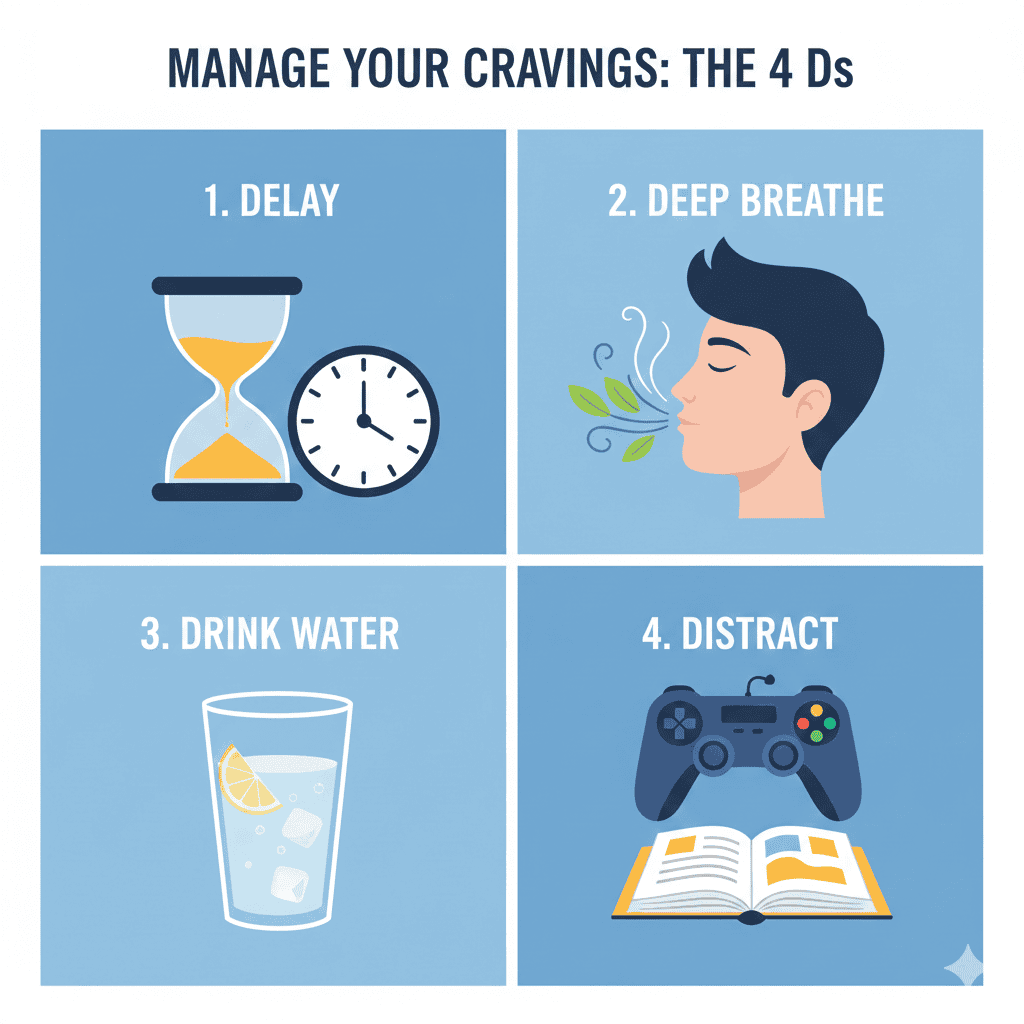
The chemistry and the experience run on different clocks. Nicotine is functionally gone from your blood within 3 days, and that is precisely when withdrawal feels worst, because the discomfort of days 1 to 3 is your brain recalibrating to absence, not the drug lingering. Cotinine hanging around for two more weeks is metabolically inert; it does not cause cravings. Meanwhile, the cravings that show up in week 3, month 2, or month 6 are not chemical at all. They are conditioned reflexes, fired by coffee, stress, alcohol, driving, and the other cues your brain spent years welding to cigarettes, which is why managing cravings is a skills problem, not a detox problem. Each cue you ride out without smoking weakens the wiring, and the urges that remain are brief: the strongest pass in three to five minutes. For the stress-shaped ones, a 90-second paced-breathing reset does the nervous-system work a cigarette was falsely getting credit for; our companion app Flow Breath is built for exactly those moments.

So read the detection windows as good news in disguise. The chemical dependency that felt permanent is, pharmacologically, a 72-hour eviction. Everything after that is learnable, and the rest of the recovery timeline is already running in your favor.

How Can Smoke Tracker Help?

The gap between "nicotine is gone in days" and "cravings last months" is exactly the stretch where most quits quietly fail, and it is the stretch the tracker is designed to carry you across.

  • Streak Counter: The 72-hour chemical eviction and the 2-week urine window both become visible milestones instead of abstractions. Watching the counter cross day 3, day 14, and day 21 turns the timelines in this article into things you have personally banked.
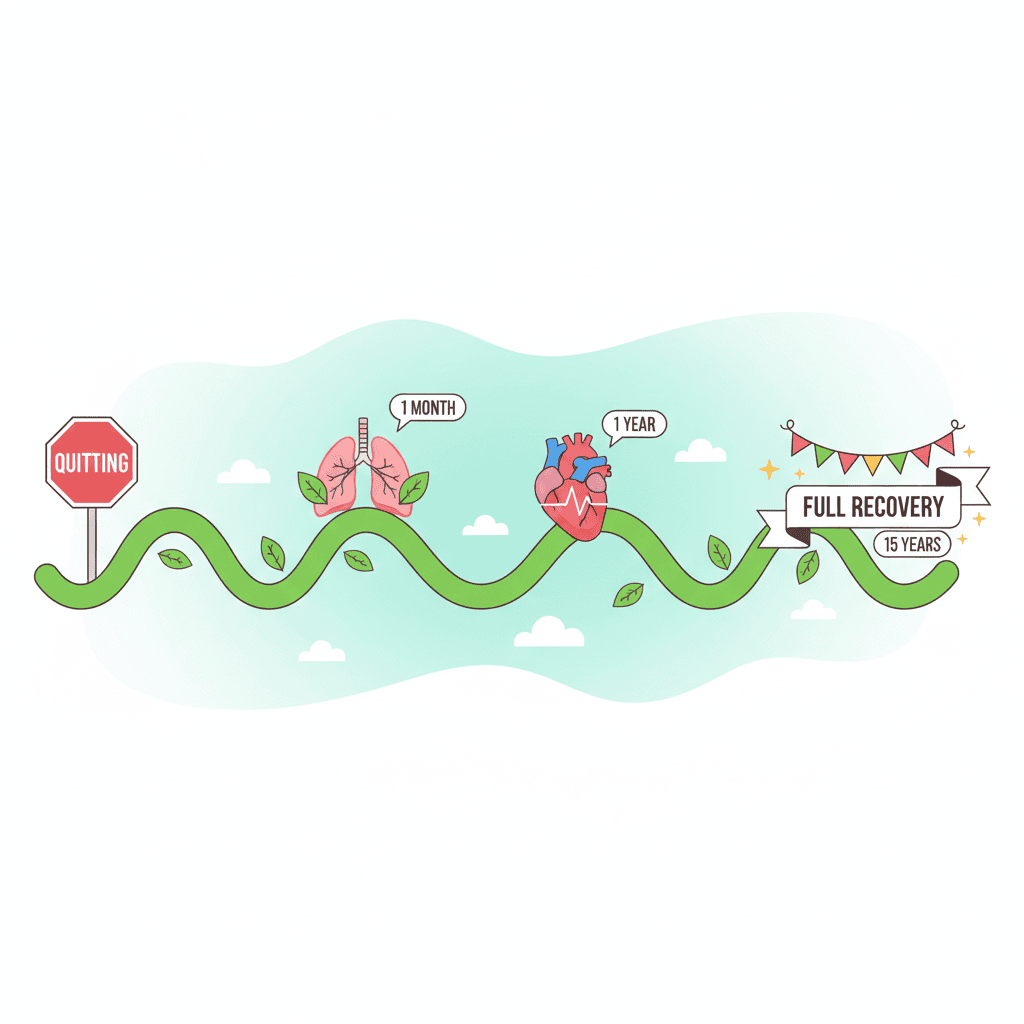
  • Health Timeline: While cotinine is still technically detectable, your circulation, heart rate, and lung function are already improving on a parallel track. Seeing both clocks running makes the inert leftover marker feel like what it is: paperwork, not addiction.
  • Craving Log: Once nicotine is chemically gone, every craving is data about a trigger, not a chemical need. Logging them reveals your personal cue map within a week, and that map is the real quitting curriculum.
  • Money Saved: If a surgery or insurance test is your deadline, the savings counter adds a second, growing number to the case for never going back after you pass it.

Nicotine leaves your blood in days, cotinine leaves your urine in weeks, and the habit leaves on the schedule you set by outlasting one cue at a time. The molecule is the easy part, and it is already on its way out.

Sources

  1. Benowitz, N. L., Hukkanen, J., and Jacob, P. (2009). "Nicotine chemistry, metabolism, kinetics and biomarkers." Handbook of Experimental Pharmacology. pubmed.ncbi.nlm.nih.gov
  2. Hukkanen, J., Jacob, P., and Benowitz, N. L. (2005). "Metabolism and disposition kinetics of nicotine." Pharmacological Reviews. pubmed.ncbi.nlm.nih.gov
  3. Centers for Disease Control and Prevention. "Biomonitoring: Cotinine." National Biomonitoring Program. cdc.gov
  4. Benowitz, N. L., et al. (2020). "Biochemical verification of tobacco use and abstinence: 2019 update." Nicotine & Tobacco Research. pubmed.ncbi.nlm.nih.gov
  5. Moyer, T. P., et al. (2002). "Simultaneous analysis of nicotine, nicotine metabolites, and tobacco alkaloids in serum or urine." Clinical Chemistry. pubmed.ncbi.nlm.nih.gov
  6. Sorensen, L. T. (2012). "Wound healing and infection in surgery: the clinical impact of smoking and smoking cessation." Archives of Surgery. pubmed.ncbi.nlm.nih.gov
  7. Benowitz, N. L., Herrera, B., and Jacob, P. (2004). "Mentholated cigarette smoking inhibits nicotine metabolism." Journal of Pharmacology and Experimental Therapeutics. pubmed.ncbi.nlm.nih.gov
  8. U.S. Department of Health and Human Services. (2020). "Smoking Cessation: A Report of the Surgeon General." cdc.gov

Common questions

How long does nicotine stay in your urine?
For regular daily users, cotinine, the metabolite urine tests look for, is typically detectable for 1 to 3 weeks after the last use, with 2 weeks being a common real-world figure for pack-a-day smokers. Light or occasional users usually clear below standard test cutoffs within 3 to 4 days. Heavy long-term users, menthol smokers, and people with slower nicotine metabolism can stay positive toward the 3-week end. Urine is the most common test type because cotinine concentrates there at several times its blood level.
Can a test tell the difference between smoking, vaping, and nicotine patches?
A standard cotinine test cannot: nicotine from any source, including cigarettes, vapes, pouches, and NRT products like patches or gum, produces the same metabolite. However, some labs add an anabasine test when it matters. Anabasine is a minor tobacco alkaloid present in cigarettes and most tobacco products but absent from pharmaceutical nicotine, so a cotinine-positive but anabasine-negative result is consistent with someone using NRT rather than smoking. If you are quitting with patches or gum before an insurance or pre-surgical test, tell the tester in advance.
How can I get nicotine out of my system faster?
Honestly: mostly by waiting. Nicotine and cotinine are processed by the liver at a rate set largely by your genetics and how saturated your system is, and that rate is not meaningfully changed by detox drinks, niacin, vinegar, or cranberry juice. Staying well hydrated, eating normally, and getting daily movement supports your liver doing its routine work, but none of it compresses a 2-week urine window into 2 days. The only reliable lever is the date of your last nicotine use, which is a good reason to set your quit date as early as possible before any test.
Why do surgeons test for nicotine before surgery?
Nicotine constricts blood vessels and reduces oxygen delivery to healing tissue, which significantly raises the risk of wound complications, infection, and failed skin grafts or implants. For elective procedures like plastic surgery, spinal fusion, and some orthopedic operations, many surgeons require patients to be nicotine-free for 4 to 6 weeks beforehand and confirm it with a urine or blood cotinine test. Because the test detects all nicotine sources, this usually means stopping vapes, pouches, and even NRT, not just cigarettes; confirm the exact policy with your surgical team.
Does nicotine leaving my body mean withdrawal is over?
No, and this is the most useful thing the timeline teaches. Nicotine is essentially gone from your blood within 3 days, which is exactly when withdrawal symptoms peak: the discomfort of days 1 to 3 is your brain recalibrating to the drug's absence, not the drug still being present. After that, cravings are increasingly behavioral, fired by coffee, stress, driving, and other conditioned cues rather than by any remaining chemical. Those situational urges keep surfacing for 1 to 3 months and fade each time you ride one out without smoking.

This article is for informational purposes only and does not constitute medical advice. Health information is based on published research from organizations such as the CDC, WHO, and American Lung Association. Always consult a healthcare professional for personalized guidance on smoking cessation.

Start Your Smoke-Free Journey Today

Download Smoke Tracker and take control of your path to a cigarette-free life.

Download on App StoreGet it on Google Play