You quit on Monday. By Friday morning, you sit down with your normal three cups of coffee and feel your heart pound, your hands shake, and your chest tighten in a way you do not remember happening before. You wonder if you are having a panic attack, a withdrawal symptom, or a cardiac problem. The honest answer is none of the above. You are drinking the same coffee you always drank. Your liver just stopped clearing it at smoker speed. This is one of the least-known and most-underrated parts of quitting, and it is also one of the easiest to fix once you know what is happening. Here is the pharmacology of caffeine after smoking cessation, the timeline of the shift, and the practical adjustments that will keep your coffee ritual without the jitters running your day.
What Is CYP1A2 and Why Does Smoking Change It?
Your liver runs a family of enzymes called the cytochrome P450 system, which metabolizes most drugs and many dietary compounds. One member of that family, CYP1A2, is responsible for breaking down caffeine and several common medications. CYP1A2 activity varies a lot between individuals based on genetics, but smoking is the single largest known environmental modifier.
The driver is not nicotine. The polycyclic aromatic hydrocarbons (PAHs) produced by burning tobacco are powerful inducers of CYP1A2 expression. The liver, exposed to PAHs daily for years, ramps up production of the enzyme to handle the chemical load. The side effect is that anything else CYP1A2 metabolizes, including caffeine, gets cleared much faster than it would in a non-smoker.
Studies measuring CYP1A2 activity have consistently found that smokers have roughly 50 to 70 percent higher enzymatic activity than non-smokers. The effect is dose-related: heavy smokers (a pack a day or more) show the largest induction, light smokers a smaller but still meaningful one. The induction is also fast in both directions. It builds over weeks of regular smoking and decays over weeks of cessation.
This is why nicotine replacement therapy (patches, gum, lozenges) does not produce the same enzyme effect. NRT delivers nicotine without the combustion products, so CYP1A2 induction wanes even while you are still using nicotine. The enzyme reset starts the moment you stop burning tobacco, regardless of whether you are also using NRT.
How Much Faster Do Smokers Clear Caffeine?
The numbers are striking once you see them.
In non-smokers, the half-life of caffeine (the time it takes for blood concentration to drop by half) averages around 5 hours. In smokers, the same half-life averages closer to 3 hours, sometimes less. That two-hour difference compounds across a day. By 9 p.m., a non-smoker who had a 2 p.m. coffee still has roughly half the caffeine in their bloodstream. A smoker has roughly a quarter or less.
This is why smokers tend to consume substantially more caffeine than non-smokers, and why heavy smokers can drink five or six cups of coffee a day and still sleep at night. They are not unusually caffeine-tolerant in a brain-receptor sense. Their livers are simply chewing through the caffeine before it has a chance to accumulate. The drink looks the same, the dose is the same, but the body is metering it out at double speed.
For more on the conditioned link between coffee and the cigarette habit itself (which is a separate phenomenon from the metabolic one), see why coffee triggers cigarette cravings.
What Happens After You Quit?
CYP1A2 activity does not wait politely for the rest of withdrawal to finish. It starts dropping within days.
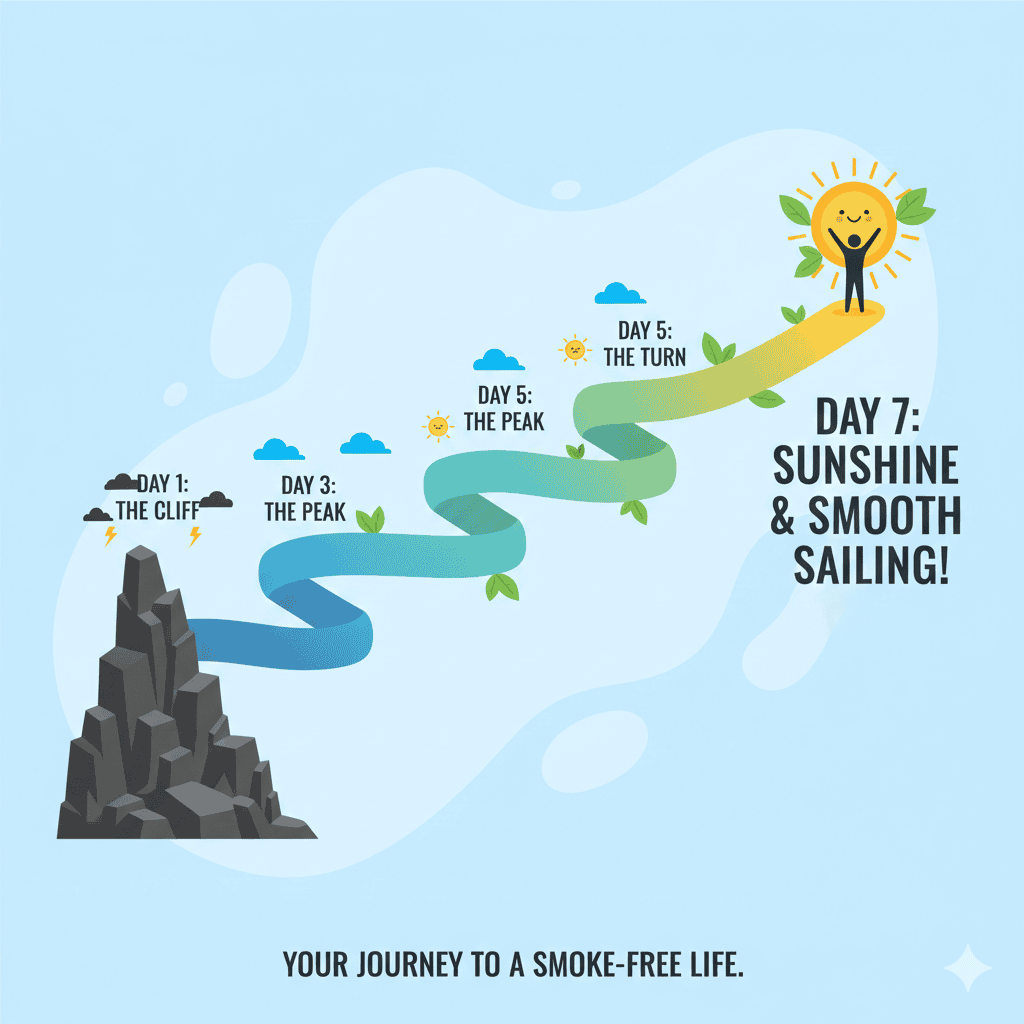
Days 1 to 4: Activity is still elevated but beginning to decline. Coffee feels roughly normal. You may already be sleeping a little worse, but most quitters do not yet attribute it to caffeine.
Days 5 to 10: CYP1A2 activity has dropped substantially, often returning to within 30 to 50 percent of non-smoker baseline. The half-life of caffeine has effectively doubled. The same morning coffee now lingers in your bloodstream into the evening. This is the window where most people first notice "my coffee feels different" or, more often, mistake the new caffeine load for anxiety, withdrawal, or a heart problem.
Weeks 2 to 4: Activity continues to decline more gradually. By the end of the first month, most former smokers have reached close to non-smoker enzyme levels. Caffeine half-life is around 4 to 5 hours, similar to a never-smoker.
Months 2 to 3: Activity stabilizes at a new baseline. The acute hit-harder phase is over, but your caffeine tolerance going forward is permanently different from what it was during your smoking years.
The crucial detail is the overlap with peak nicotine withdrawal. Days 3 to 10 are also when nicotine cravings, irritability, and anxiety are at their worst. Layering a doubled caffeine half-life on top of that withdrawal load is what produces the classic "I feel terrible and my heart is racing and I cannot sleep" experience that pushes many quitters back to cigarettes. Our first week smoke-free guide lays out the full early-quit symptom map alongside this one.
Why This Compounds Withdrawal Symptoms
Three withdrawal complaints are particularly amplified by the caffeine shift, and recognizing them changes how you handle them.
Anxiety and jitters. Caffeine is anxiogenic at high enough blood levels. The doubled half-life means your bloodstream is now operating at the upper end of where it used to sit, all day long. Anxiety that feels like nicotine withdrawal is often partially or mostly excess caffeine. Many former smokers who cut their coffee in half during the first two weeks report a dramatic reduction in what they assumed was emotional withdrawal. Our piece on morning anxiety in smokers covers the related phenomenon of overnight nicotine withdrawal anxiety, which interacts with this.
Heart palpitations. Caffeine raises heart rate and can produce premature beats in sensitive individuals. At smoker-cleared doses these were transient. At post-quit clearance rates, the same intake can produce noticeable palpitations, especially in the afternoon and evening. People often interpret these as cardiovascular damage from years of smoking. The cardiovascular damage is real and worth taking seriously, but the immediate palpitations in the first weeks are usually caffeine.
Insomnia. This is the worst of the three because sleep loss directly drives relapse. Caffeine consumed at noon is now still meaningfully present at midnight. Quitters who push through without adjusting often spend the first two weeks running on six hours of fragmented sleep, which makes everything else worse, including cravings, mood, and cognitive function.
The cruel pattern is that all three of these symptoms feel like proof that smoking was holding you together. They are nothing of the sort. They are the predictable consequence of a metabolic shift that has nothing to do with nicotine and everything to do with the absence of combustion products in your liver.
What Other Medications Are Affected?
This is the part of the story almost no one talks about, and it actually matters more for some people than the caffeine question.
CYP1A2 metabolizes a long list of medications, several of which are commonly prescribed and several of which have narrow therapeutic windows. Quitting smoking can substantially raise blood levels of these drugs without any change in dosage. The clinically important ones include:
Clozapine and olanzapine (antipsychotics). Smoking can lower clozapine levels by 30 to 50 percent. Patients who quit smoking on stable clozapine doses can become acutely toxic within 1 to 2 weeks if their dose is not reduced. This is well-documented enough that psychiatric guidelines explicitly recommend dose adjustment at smoking cessation. If you take clozapine or olanzapine and are quitting, your prescriber needs to know now, not after.
Theophylline (used in asthma and COPD). Smokers clear theophylline roughly twice as fast. Quitting raises blood levels significantly and can cause toxicity (nausea, headache, arrhythmia) at previously stable doses.
Propranolol and some other beta-blockers. Levels rise modestly after quitting. The effect is usually clinically minor but worth flagging.
Warfarin (anticoagulant). Smoking has a modest effect on warfarin clearance, and INR can shift after quitting. Anyone on warfarin should have their INR checked within 2 to 4 weeks of cessation.
Tizanidine, ropinirole, mexiletine, and several others with narrower clinical use can also shift.
The general rule is that anyone on a chronically dosed medication should mention to their prescriber that they have quit smoking. The conversation takes 30 seconds and can prevent toxicity that would be misattributed to something else. This is not a fringe concern. It is one of the better-documented interactions in clinical pharmacology and is routinely missed because nobody connects the new symptom to the recent quit.
How to Dose-Adjust Your Caffeine
The fix is straightforward once you know the math. Treat the first month post-quit as a period where your usual caffeine intake is now an over-dose, and titrate.
Cut total intake by half for the first 2 weeks. Three cups becomes one and a half. Four becomes two. The point is to undershoot the new metabolic reality, not match the old one. Most former smokers find this brings caffeine-driven symptoms (anxiety, palpitations, insomnia) under control within a few days.
Stop caffeine by noon. With a doubled half-life, a 2 p.m. coffee is functionally equivalent to a 10 p.m. coffee in your old smoker physiology. Anything past lunch will measurably interfere with sleep onset and depth. Sleep loss in the first weeks of quitting is one of the strongest single predictors of relapse, so this is not a minor lever.
Switch to half-caf or smaller cups for the morning ritual. Keeping the ritual but reducing the dose preserves the conditioned reward of the morning routine without overshooting. Many former smokers find half-caf in a familiar mug indistinguishable from the full-strength version they were drinking before.
Hydrate aggressively. Caffeine has mild diuretic effects, and dehydration on top of nicotine withdrawal worsens headaches and fatigue. Two extra glasses of water a day during the first month is not a wellness platitude in this specific context, it is real.
Reassess at week 4. Once CYP1A2 has substantially normalized, you can carefully add caffeine back to whatever level feels right at non-smoker pharmacokinetics. Many former smokers settle at 30 to 50 percent below their smoking-era intake permanently because their tolerance simply does not return to the old level.
Watch for the late-day rebound. A common pattern is morning energy is fine on the new lower dose, then early afternoon brings a slump, and the temptation is to have a 3 p.m. coffee. That coffee will wreck your sleep. Better options are a short walk, a glass of water, or a 20-minute nap.
For the moments when caffeine, withdrawal, and stress collide and the urge to smoke spikes, slow paced breathing can shift the autonomic system out of fight-or-flight in about 90 seconds. We built Flow Breath for exactly that kind of short, situational regulation, and it pairs particularly well with the post-quit period when the body is recalibrating on multiple axes at once.
What Happens If You Just Push Through?
Some people refuse to touch their coffee intake on principle and try to power through. The pattern is predictable.
Sleep degrades over the first 7 to 10 days. Anxiety climbs. Heart rate variability drops. Cognitive performance dips noticeably during the second week. Many quitters in this category give up around day 10 to 14, often citing "withdrawal" or "I just felt terrible all the time" as the reason. A meaningful fraction of those quits would have held if the caffeine load had been adjusted. The cigarette is taking the blame for what the coffee is partly doing.
Pushing through is not heroic. It is choosing to fight your withdrawal with one hand tied behind your back. Cutting caffeine in half for two weeks is the single highest-leverage thing you can do in the first month aside from not smoking, and almost nobody is told to do it.
How Can Smoke Tracker Help You Manage the Caffeine Shift?
The metabolic reset is invisible from the outside, but a few features make the pattern legible.
- Streak Counter: The first 10 days, where the caffeine shift is steepest, are the days where the streak feels most fragile. Watching the number tick upward gives you a tangible reason to make the small adjustments (smaller cup, no afternoon coffee) that protect it.
- Craving Log: Note the time of day and your last caffeine dose alongside each craving. The pattern of cravings clustering around afternoon caffeine slumps becomes obvious within a week, and the fix follows naturally.
- Health Timeline: The same enzyme reset that changes your caffeine response is part of the broader liver and metabolic recovery. Cross-referencing your symptoms with where you are on the timeline reframes "I feel terrible" as "this is exactly the day where this would happen, and it is short."
- Money Saved: Use part of the savings on better coffee in smaller doses. A single high-quality cup at the right time of day is a more sustainable post-quit ritual than three mediocre ones.
The body is unwinding more changes than you can feel from the inside, and the caffeine shift is one of the loudest and most fixable of them. Cut the dose. Stop earlier in the day. Adjust your medications with your prescriber. Then watch the version of withdrawal you are actually living through become noticeably more humane than the version most people warn you about.
The smoke is gone, the enzyme is resetting, and the coffee is the same. The math has changed, that is all.
Sources
- Faber, M. S. and Fuhr, U. (2004). "Time response of cytochrome P450 1A2 activity on cessation of heavy smoking." Clinical Pharmacology and Therapeutics. pubmed.ncbi.nlm.nih.gov
- Zevin, S. and Benowitz, N. L. (1999). "Drug interactions with tobacco smoking. An update." Clinical Pharmacokinetics. pubmed.ncbi.nlm.nih.gov
- Lucas, C., et al. (2013). "Smoking and drug interactions." Australian Prescriber. australianprescriber.tg.org.au
- Swanson, J. A., Lee, J. W., and Hopp, J. W. (1994). "Caffeine and nicotine: a review of their joint use and possible interactive effects in tobacco withdrawal." Addictive Behaviors. pubmed.ncbi.nlm.nih.gov
- Hukkanen, J., Jacob, P., and Benowitz, N. L. (2005). "Metabolism and disposition kinetics of nicotine." Pharmacological Reviews. pubmed.ncbi.nlm.nih.gov
- de Leon, J. (2004). "Atypical antipsychotic dosing: the effect of smoking and caffeine." Psychiatric Services. pubmed.ncbi.nlm.nih.gov
- Mayo Clinic. "Caffeine: How much is too much?" mayoclinic.org
This article is for informational purposes only and does not constitute medical advice. Health information is based on published research from organizations such as the CDC, WHO, and American Lung Association. Always consult a healthcare professional for personalized guidance on smoking cessation.