Somewhere in the last few months, the counting stopped. You do not know today's day count the way you knew day nine, and the quit date that once organized your entire calendar now has to be looked up. A year in, not smoking is no longer something you are doing. It is something you are.
That is exactly why the anniversary deserves a deliberate look. One year is the first milestone that comes with a formal medical payoff, the point where the statistics move from favorable to overwhelming, and, less comfortably, the date that invites its own specific brand of relapse. Here is what a full year without cigarettes has actually bought you, and what the road ahead still holds.
The Milestone Your Heart Was Waiting For
Every recovery timeline, from the CDC to the WHO, marks one year with the same line: your excess risk of coronary heart disease is now about half that of a continuing smoker.
It is worth unpacking what that means, because it is the first hard cardiovascular milestone on the official list. Smoking attacks the heart through blood vessel inflammation, reduced oxygen delivery, and a chronically elevated heart rate, and those mechanisms began shutting down within days of your last cigarette. Resting heart rate and blood pressure settled months ago. What the one-year figure measures is the cumulative effect: a year of vessels healing instead of being injured has cut the added heart attack risk you were carrying roughly in half. The full heart recovery timeline continues from here, with excess coronary risk approaching a never-smoker's over about fifteen years and stroke risk reaching a non-smoker's range within roughly two to five.
None of this announces itself. Your heart does not send a congratulations notification, which is precisely why the milestone is worth marking consciously: it is the largest single health event of your year, and it is completely silent.
The Odds at Twelve Months: 95 Percent
The behavioral statistics at one year are not just better than before. They are a different genre.
The continuous-abstinence data that tracked this blog's earlier milestones tells the whole story in one ladder. Of people whose quit had lasted under a month, about 12 percent went on to stay quit. One to three months: 25 percent. Three to six months: 52 percent. Six to twelve months: 59.2 percent. Past one year, the same dataset found roughly 95 percent still abstinent at follow-up. A meta-analysis devoted specifically to late relapse fills in the long tail: among people abstinent at twelve months, about 10 percent eventually smoke again, at roughly 2 to 4 percent per year in prospective studies, a rate that keeps falling as the years accumulate.
Read that against where you started. Roughly three quarters of quit attempts collapse before six months, and you are now on the far side of a filter that removed almost every way a quit can die. The residual risk is real, which is why this article does not end here, but it is thin, concentrated, and, most importantly, nameable in advance.
What Has Healed, and What Is Still on the Clock
Finished. The entire visible recovery is complete. Cilia regained normal function inside the one-to-nine-month repair window, so the lung healing you could feel, the fading cough, the quieter stairs, wrapped up months ago. Taste, smell, skin, sleep, circulation, immune function: all of it stopped being an improvement and became your baseline. One flag worth planting: a cough that still persists at twelve months is no longer part of quitting, and it belongs in a doctor's office, not in the "still healing" folder.
Stabilizing. If you gained weight this year, you have company: meta-analysis of post-cessation weight change finds an average gain of 4 to 5 kilograms at twelve months, with most of it arriving in the first three. The curve flattens from here, and the weight gain guide covers the levers that actually move it. The trade remains lopsided in your favor: the cardiovascular benefit of quitting outweighs the risk added by typical post-quit weight gain.
Still bending. The curves that matter for the next decade are the silent ones. Stroke risk approaching a non-smoker's within two to five years. Lung cancer risk halving around year ten, with mouth, throat, esophagus, and bladder cancer risks declining alongside it. Coronary risk closing the last gap over fifteen years. The cancer risk timeline lays out the full decade, and if you quit late in life, the evidence in is it too late to quit says the curves bend at every age.
Cravings, Dreams, and the Last Ghosts
At one year, most people report weeks or months of not thinking about smoking at all. What punctuates the silence is the ambush: a sudden, specific, surprisingly sharp urge fired by a cue you have never yet faced as a non-smoker. A first funeral. A first real crisis. The first trip back to a city where you smoked on every corner. The urge peaks and passes within minutes, and a cue survived once tends to stay defused for good.
The playbook for those minutes has not changed, it just gets used less: slow paced breathing at around six breaths a minute remains the fastest way to move the nervous system while the wave passes, and our companion app Flow Breath packages exactly that 90-second intervention. The long-range expectations are mapped in how long cravings last.
Two leftovers are worth naming so they do not unsettle you. Smoking dreams can continue well past a year, sometimes vivid enough to wake you convinced you relapsed; they are memory consolidation, not desire. And the occasional idle thought about cigarettes, urge-free, can surface for years. A thought is not an urge, an urge is not an action, and neither is a verdict on your quit.
The Anniversary Traps
Late relapse has a strange property: it clusters around success. Nobody at one year smokes because withdrawal wore them down. They smoke because the milestone itself opened a door. Three doors, specifically.
The anniversary cigarette. One year of success generates the most elegant relapse logic ever devised: "I've proven I'm free of it, so one cigarette to mark the occasion can't own me." The evidence on one cigarette after quitting does not soften with time: a single cigarette during a quit remains among the strongest predictors of full relapse, at month twelve as at week two. An anniversary is a fine thing to celebrate. Celebrate it with literally anything else.
The social smoker audition. A cousin of the first trap, but slower: not one cigarette tonight, but a quiet plan to become someone who smokes twice a month at parties. You have a year of evidence about who you are around cigarettes, and it did not feature moderation. Alcohol remains the strongest cross-trigger there is, and nearly every audition for social smoking is staged with a drink in hand.
The crisis exception. At some point in the coming years, something will genuinely go wrong: a job, a marriage, a diagnosis, a loss. The old exit sign will light up, dressed as fairness: "given what's happening, I'm allowed." Decide now, while nothing is wrong, that smoking is not on the crisis menu, and keep the relapse protocol somewhere you can find it, because a slip handled inside 24 hours stays a footnote, and a slip plus despair becomes a chapter.
What to Do at the One-Year Mark
Mark the date, on purpose. Not with a cigarette and not with nothing. A year of compound daily effort deserves a deliberate ritual: a dinner, a trip, a purchase, a phone call to whoever helped. Milestones that go unmarked stop functioning as milestones.
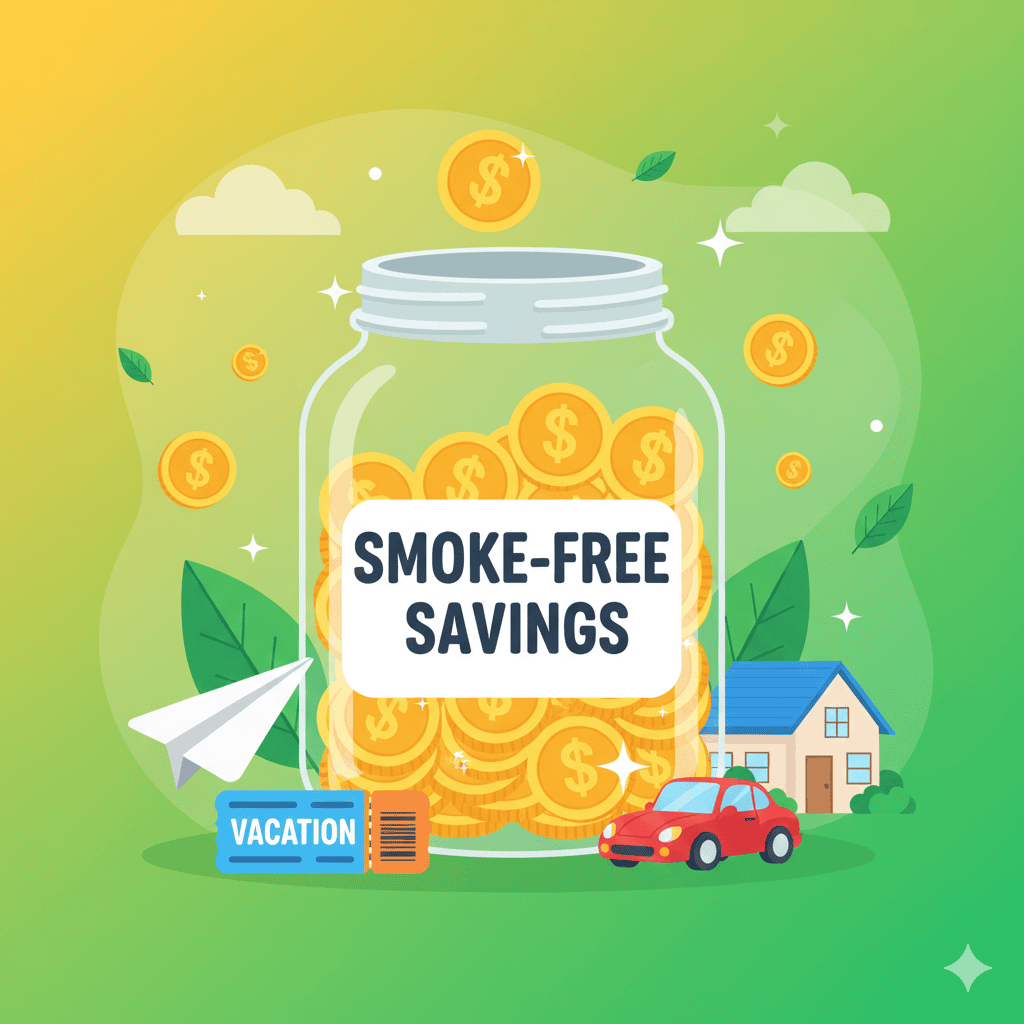
Audit and spend the money. A pack-a-day smoker has roughly $2,900 banked at US prices, dramatically more in the UK or Australia. Run your own numbers in the savings breakdown, then convert a deliberate slice into something you can point at. An object you own argues against a future bad week far better than a balance does.
Check the mood direction, honestly. For most quitters, the BMJ meta-analysis holds: anxiety, depression, and stress are all lower at one year than they were as a smoker, with mental health gains comparable to antidepressant treatment. If your mood a year in is flat or worse instead, that trend is information, not impatience. A 30-second daily check-in with our companion app AnxietyPulse makes the direction visible over weeks and gives a doctor something concrete to look at.
Become someone's evidence. Nothing consolidates an identity like being proof it works. If someone around you is trying to quit, your existence is now data: the first week they are dreading is a week you survived. Offer the map.
How Can Smoke Tracker Help After a Year?
Past twelve months, the app stops being a coping tool and becomes a record keeper, because the danger is no longer how you feel. It is what you forget.
- Streak Counter: A 365-day streak is an asset with real weight. Seeing the number at a weak moment converts "just one" from a small decision into a visible trade.
- Health Timeline: The improvements you could feel ended months ago; the ones that matter now run on five and ten-year clocks. The timeline keeps stroke and cancer-risk progress on screen through the years when your body sends no more updates.
- Money Saved: Past $2,900 and counting, the tracker turns year two's savings from an abstraction into a running income you can assign to something.
- Achievements: The milestone badges give the long, quiet years the same structure the loud early weeks had, so the anniversary never sneaks past unmarked again.
One year smoke-free is the milestone that feels like nothing and means the most. The heart risk is halved, the odds have moved to 95 percent, the repair you could feel is finished, and the entire remaining threat fits in three named situations you can plan for on one page. You are not quitting anymore. You are a non-smoker with a good story, and the only job left is to keep telling it.
At 1 year smoke-free, excess coronary heart disease risk is down to half a smoker's, and about 95 percent of people who reach this point stay quit, with late relapse running at just 2 to 4 percent per year. Visible healing is complete; the silent risk curves keep improving for a decade. The remaining risks are the anniversary cigarette, alcohol, and crisis: name them in advance and the second year is yours.
Sources
- Gilpin, E. A., Pierce, J. P., Farkas, A. J. (1997). "Duration of smoking abstinence and success in quitting." Journal of the National Cancer Institute. academic.oup.com
- Hughes, J. R., Peters, E. N., Naud, S. (2008). "Relapse to smoking after 1 year of abstinence: a meta-analysis." Addictive Behaviors. pubmed.ncbi.nlm.nih.gov
- Hughes, J. R., Keely, J., Naud, S. (2004). "Shape of the relapse curve and long-term abstinence among untreated smokers." Addiction. pubmed.ncbi.nlm.nih.gov
- Taylor, G., McNeill, A., Girling, A., et al. (2014). "Change in mental health after smoking cessation: systematic review and meta-analysis." BMJ. bmj.com
- Centers for Disease Control and Prevention. "Benefits of Quitting Smoking." cdc.gov
- American Cancer Society. "Health Benefits of Quitting Smoking Over Time." cancer.org
- Aubin, H. J., Farley, A., Lycett, D., et al. (2012). "Weight gain in smokers after quitting cigarettes: meta-analysis." BMJ. bmj.com
- US Department of Health and Human Services (2020). "Smoking Cessation: A Report of the Surgeon General." hhs.gov
- World Health Organization. "Tobacco: Health benefits of smoking cessation." who.int
Common questions
- What happens after 1 year of not smoking?
- One year is the first milestone with a formal cardiovascular payoff attached: your excess risk of coronary heart disease is now about half that of someone who kept smoking, a figure that appears on the CDC, American Cancer Society, and WHO recovery timelines alike. Everything you could feel has long since finished healing. The cilia in your airways completed their repair inside the one-to-nine-month window, the quitter's cough and breathlessness resolved, circulation and blood pressure settled within the first months, and taste, smell, sleep, and energy became your baseline so long ago that they no longer register as improvements. Mood is measurably better too: a BMJ meta-analysis found anxiety, depression, and stress all decrease after cessation compared with continuing to smoke. What continues in the background is the slow bending of the risk curves: stroke risk approaches a non-smoker's within about two to five years, lung cancer risk falls by half around year ten, and coronary risk keeps declining toward a never-smoker's over about fifteen years. At one year, your body has done the fast half of the work. The slow half no longer needs anything from you except not smoking.
- Can you still relapse after 1 year smoke-free?
- It happens, but it is now rare, and it almost never looks like a craving winning. In the classic continuous-abstinence dataset, about 95 percent of people who had been quit for a year or more stayed abstinent through follow-up, and a meta-analysis of late relapse found that among people abstinent at twelve months, roughly 10 percent eventually smoke again, at a rate of about 2 to 4 percent per year in prospective studies. Compare that with the roughly 75 percent of quit attempts that fail before six months, and one year is statistically a different world. When late relapse does happen, the anatomy is consistent: it is not withdrawal, which ended months ago, but a deliberate experiment. A cigarette accepted to celebrate the anniversary, a cigar on vacation that felt exempt, a pack bought during a divorce, a layoff, or a bereavement. Research on lapses is blunt about where experiments lead: smoking even one cigarette during a quit remains among the strongest predictors of returning to regular smoking, and reaching a year does not switch that finding off. The practical defense is knowing your three exposures in advance: alcohol, acute crisis, and the confidence test.
- Are my lungs back to normal after a year without smoking?
- Functionally, close to it; statistically, the repair is still in progress, and both halves of that answer matter. The symptomatic recovery is complete: the cilia that sweep debris out of your bronchial tubes regained normal function within the one-to-nine-month window, coughing and shortness of breath have resolved for most quitters, and follow-up spirometry studies document measurable gains in lung function across the first year. A cough that persists at twelve months is not a normal part of quitting anymore and deserves a doctor's visit rather than patience. The longer arc runs on a decade clock: excess lung cancer risk falls to about half a continuing smoker's roughly ten years after quitting, and risk for cancers of the mouth, throat, esophagus, and bladder declines over the same years. If smoking left structural damage such as COPD, quitting does not reverse it, but it slows further decline to close to a non-smoker's rate, which is why lung function a year in is the best it will be on any path that included smoking. The honest summary: your lungs feel done healing at one year, and they will quietly keep lowering your risk for another decade if you let them.
- Why do I still think about cigarettes a year after quitting?
- Because memory outlives chemistry, and only the chemistry had a deadline. Nicotine receptor density returned to non-smoker levels around the three-month mark, so nothing your body does at one year is withdrawal. What surfaces now is associative: years of smoking welded cigarettes to thousands of specific contexts, and the rare ones you have still never faced as a non-smoker, a first funeral, a first layoff, a first trip to a country where everyone smokes, can fire a sudden, sharp urge when you finally meet them. The characteristic pattern at this stage is months of total silence, then one specific ambush that peaks and passes within a few minutes, and each cue you sit through once tends to stay defused. Occasional idle thoughts about smoking, with no urge attached, can surface for years and mean nothing: a thought is not an urge, and an urge is not an action. Smoking dreams belong in the same folder, and they can stay vivid surprisingly long: they are a byproduct of memory consolidation, not a message about desire, and quitters routinely report them past the one-year mark. None of this is evidence of an incomplete quit. It is evidence that you smoked for years, and that the brain keeps old maps long after it stops using them.
- How much money do you save after 1 year of not smoking?
- A pack-a-day smoker at average US prices has roughly $2,900 banked at the one-year mark, and in high-tax markets the figure is far larger: comfortably past £4,000 in the UK and past AU$9,000 in Australia at typical pack prices. Heavier smoking, premium brands, or big-city prices push it higher, and the pack math still undercounts the true total, because it ignores dental work, sick days, insurance loadings, and the assorted quiet costs that follow smoking around. What matters at one year is what the number does next. Research on incentives and habit change, and ordinary common sense, point the same way: money that dissolves into the current account defends nothing, while savings converted into one concrete, visible thing, a trip taken, an instrument bought, a debt cleared, turn the abstract streak into an owned result that a future bad week has to argue against. One year is the natural point to audit the real total against your own prices, spend a deliberate portion of it on something you can point at, and give the second year its own target, because from here the savings stop being a recovery fund and start being an income.
This article is for informational purposes only and does not constitute medical advice. Health information is based on published research from organizations such as the CDC, WHO, and American Lung Association. Always consult a healthcare professional for personalized guidance on smoking cessation.