It arrives quietly, usually when things are going well. Three weeks in, maybe three months, the hard part supposedly behind you, and a voice says: you have proven you can quit, so one cigarette is nothing now. At a party, holding a drink. After a brutal day. During a celebration, even. The thought feels calm and reasonable, nothing like the ragged cravings of week one, and that is exactly what makes it the most dangerous moment of your entire quit.
This article takes that thought seriously instead of just scolding it. Here is what one cigarette actually does to a recovering brain, what the research honestly says about where "just one" leads, and how to get through the moment without finding out the hard way.
Why "Just One" Feels So Convincing
The first thing to understand is that the thought itself is a symptom, not an insight.
Nicotine addiction lives in the brain's associative learning system, the same machinery that makes any deeply practiced habit automatic. Over years of smoking, thousands of repetitions welded cigarettes to specific moments: coffee, stress, alcohol, breaks, relief, reward. Quitting stops the nicotine, but it does not delete the wiring. It goes dormant, and dormant circuits can still talk.
What they say is remarkably predictable. Researchers who study relapse call these permission-giving thoughts, and they follow a script: I have earned it. One won't hurt. I will just have one tonight and none tomorrow. I need to know I can be normal around cigarettes. Notice that every version has the same structure: it is a negotiation whose only possible outcome is smoking.
Two biases stack the deck. Euphoric recall means memory serves up the pleasure of past cigarettes in high definition while quietly deleting the cough, the smell, the self-disgust, and the fact that most of those cigarettes were not even enjoyable. And timing matters: these thoughts tend to strike when your guard is down, during celebrations, after alcohol, or in the calm stretch after acute withdrawal ends, when the daily crush of cravings has faded and vigilance feels unnecessary.
Recognizing the script is half the defense. The thought is not you deciding; it is the old circuit proposing. You are the one who gets to answer.
What One Cigarette Does to a Recovering Brain
Here is the honest physiology, both sides of it.
The reassuring side: one cigarette does not undo your physical healing. The carbon monoxide from a single smoke clears your blood within about a day. Your heart rate and blood pressure return to their new, improved baseline within the hour. The cilia regrowing in your airways do not die off because of one exposure, and the lung recovery you have built keeps going. Physically, one cigarette is a pebble on the tracks, not a derailment.
The dangerous side is neurological. Since your quit day, the nicotinic receptors that multiplied during your smoking years have been steadily returning toward never-smoker levels, and the dopamine circuit that fired for cigarettes has been learning, repetition by repetition, that smoking no longer happens. One cigarette interrupts that lesson with a full-volume counterexample. Nicotine floods the receptors within seconds, dopamine spikes, and the brain registers, vividly, that the old lever still works.
The practical consequence is something researchers call priming: rather than satisfying the craving, that cigarette typically amplifies the next one. In the days after a single smoke, most people report cravings that are stronger, more frequent, and more insistent than the week before. You have not returned to day one of withdrawal, but you have handed the dormant circuit a fresh piece of evidence, and it will spend the next several days replaying it.
The Honest Numbers on Where One Leads
Prospective studies, the kind that follow quitters forward in time, are blunt about this.
Research on smoking lapses has repeatedly found that taking even a single puff during a quit attempt is among the strongest predictors of full relapse. In one of the most cited findings, from studies by Kenford and colleagues, quitters who smoked at all during the first two weeks were dramatically more likely to be smoking again at six months than those who stayed completely clean. Across the literature, the majority of lapses, with estimates ranging from half to as high as 90 percent depending on the study and how quickly people respond, eventually progress to a return to regular smoking.
The mechanism is rarely the first cigarette itself. It is the second, and the story between them. Psychologists call it the abstinence violation effect: the moment you frame the slip as proof of failure, "I have no willpower, I have ruined it, I might as well smoke," continuing becomes the path of least resistance. The cigarette breaks the streak; the story breaks the quit.
And this is why the numbers, grim as they look, are not a prophecy. The lapses that do not become relapses share a pattern: the person stopped at one, responded within a day, and treated the slip as information. Our guide on what to do after a slip walks through that recovery playbook step by step. The statistics describe what happens by default. You are allowed to not be the default.
The Social Smoker Fantasy
A quieter version of "just one" is the plan to become an occasional smoker: no packs, no mornings, just a few at parties, like those people who seem to take or leave cigarettes.
Those people are real, but they were never you. So-called social smokers who sustain genuinely occasional smoking mostly never developed dependence in the first place; their brains never built the receptor density and trigger network that years of daily smoking build. Yours did. That structure does not unlearn, it goes dormant, and reactivating it does not require rebuilding the addiction from scratch, only waking it.
Which is why the trajectory for former daily smokers who try controlled smoking is so consistent: the weekend cigarette recruits a weekday evening, the evening cigarette recruits a second, and at some point the morning cigarette returns, the single most reliable marker of restored dependence. Often the slide takes only weeks. Alcohol accelerates everything here, which is no coincidence: drinking and smoking are deeply cross-wired, and most "just one" moments happen with a glass in hand.
For an ex-daily smoker, the stable number of cigarettes is not "a few." It is zero. Zero is not deprivation; it is the only setting at which the old circuit stays asleep.
How to Get Through the "Just One" Moment
The urge that feels permanent is, measurably, a wave: it builds, peaks, and passes within about three to five minutes whether or not you smoke. Every technique below is a way to still be standing when it breaks.
-
Name it out loud. Literally: "this is a permission-giving thought, not a decision." Labeling the thought as a symptom strips most of its authority and buys you the seconds you need to choose a response.
-
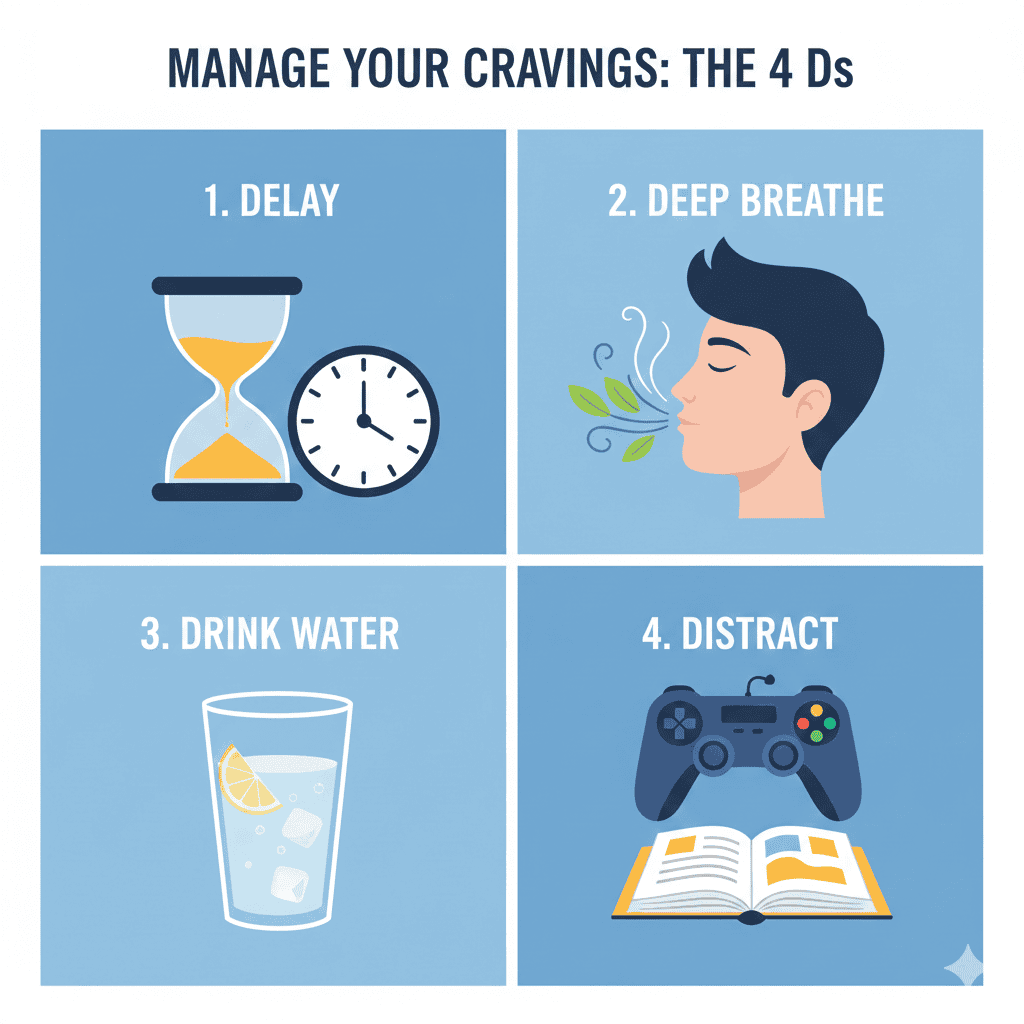
Delay by ten minutes, with a timer. Do not argue with the urge; postpone it. Set an actual timer. The negotiation "I can smoke when it rings, if I still want to" almost always ends with the wave already passed.
-
Breathe through the peak. Slow, paced breathing, about six breaths a minute for two or three minutes, directly downshifts the stress arousal that cravings ride on. Our companion app Flow Breath is built for exactly these 90-second situational resets: open it, follow the pacer, and let the wave crest while your hands are busy doing something that is not lighting a cigarette.
-
Play the tape forward. Euphoric recall shows you only the first drag. Deliberately run the whole film: the dizzy, ashy reality of the actual cigarette, the smell on your fingers, tomorrow's guilt, the harder cravings all next week, explaining the broken streak to yourself. The fantasy rarely survives its own ending.
-
Change the scene. Urges are wired to contexts. Step outside the smoking area, leave the balcony, go to the bathroom and wash your face, get a glass of water. A 30-second change of location and posture disrupts the cue that fired the craving in the first place.
-
Retrieve your reasons. In the moment, the reasons you quit are abstract and the cigarette is concrete. Reverse that: keep your original quit-day list, your kids, your health scare, the money, where you can reach it in ten seconds. Concrete beats abstract; make your reasons the concrete thing.
If the moment has already passed and the cigarette got smoked, skip the self-flagellation and go straight to the slip recovery playbook: no second cigarette, trigger autopsy, defenses restarted within 24 hours.
How Can Smoke Tracker Help You Through It?
The "just one" moment is a fight between a vivid immediate impulse and abstract long-term progress, and the tracker's job is to make your progress just as vivid and just as immediate.
- Streak Counter: The single most effective counterweight to "one won't hurt" is a number you do not want to reset. Opening the app and looking at the streak turns an abstract quit into a concrete thing you own, ten seconds before you decide whether to trade it.
- Craving Toolkit: The delay timer, breathing exercises, and distraction strategies live exactly where you need them in the critical five minutes. The moment the permission-giving thought speaks up is the moment to open the toolkit instead of the negotiation.
- Health Timeline: Seeing precisely which repairs are underway right now, and which milestone is days away, gives the tape-forward technique real data: this is what one cigarette would interrupt.
- Money Saved: The running total makes the trade explicit. "Just one" is never priced at one cigarette; it is priced at the pack it opens the door to, and the counter shows what that money has been becoming instead.
The thought will probably come, whether at week three or year two, and it will sound reasonable, because it is speaking with your own voice. It is still just the old circuit testing the lock. One cigarette will not destroy your body, but it was never really about one cigarette, and some part of you knows that, which is why you are reading this instead of smoking.
The urge is a wave that passes in minutes; the relapse it invites lasts years. Name the thought, delay it, breathe through the peak, and keep the number at zero.
Sources
- Kenford, S. L., et al. (1994). "Predicting smoking cessation: who will quit with and without the nicotine patch." JAMA. pubmed.ncbi.nlm.nih.gov
- Shiffman, S., et al. (1996). "First lapses to smoking: within-subjects analysis of real-time reports." Journal of Consulting and Clinical Psychology. pubmed.ncbi.nlm.nih.gov
- Marlatt, G. A., and Donovan, D. M. (2005). "Relapse Prevention: Maintenance Strategies in the Treatment of Addictive Behaviors." Guilford Press.
- Brandon, T. H., et al. (1990). "Postcessation cigarette use: the process of relapse." Addictive Behaviors. pubmed.ncbi.nlm.nih.gov
- Benowitz, N. L. (2010). "Nicotine addiction." New England Journal of Medicine. pubmed.ncbi.nlm.nih.gov
- U.S. Department of Health and Human Services. (2020). "Smoking Cessation: A Report of the Surgeon General." ncbi.nlm.nih.gov
- National Cancer Institute (smokefree.gov). "Slips and Relapses." smokefree.gov
Common questions
- Can I smoke just one cigarette after quitting?
- Physically, one cigarette will not erase weeks of healing: your heart rate and carbon monoxide levels return to your improved baseline within hours, and your lung recovery continues. Neurologically, it is a different story. That one cigarette delivers a full dose of nicotine to receptors that have been resensitizing since your quit day, lights up the exact dopamine pathway you have spent weeks quieting, and reminds your brain, vividly, that a cigarette 'works.' In practice, most people find cravings come back harder and more often in the days after a single smoke, and studies consistently show that even one puff during a quit attempt sharply raises the odds of returning to regular smoking. So the honest answer is: you can, but it almost never stays at one, and the pleasure is far smaller than the price.
- Will one cigarette ruin all my progress?
- No, and this matters just as much as the risk. One cigarette does not reset your body. The carbon monoxide from a single smoke clears within about a day, your blood pressure and circulation stay near their improved baseline, your cilia keep regrowing, and the receptor normalization built over weeks of abstinence is dented, not demolished. What one cigarette can ruin is the psychological momentum, and only if you let the wrong story take over. The thought 'I have already blown it, so I might as well keep smoking' is called the abstinence violation effect, and it, not the cigarette itself, is what converts a 10-minute mistake into a full relapse. Treat a slip as data, not destiny: figure out the trigger, throw away any remaining cigarettes, and resume your quit immediately.
- Why do I still want a cigarette months after quitting?
- Because addiction memory outlives withdrawal. The physical dependence on nicotine fades within weeks, but the associative learning, thousands of repetitions pairing cigarettes with coffee, stress, drinks, driving, and breaks, is stored durably in the brain. Months in, a strong trigger like alcohol, a crisis, or even a sudden good mood can fire that old circuit and produce a craving that feels like it came from nowhere. This is normal, expected, and not a sign your quit is failing. These late urges are less frequent and shorter than early withdrawal cravings, typically passing in a few minutes, and each one you outlast weakens the association a little further. The danger is only in misreading them as proof that you 'need' to smoke, or as permission to test yourself with just one.
- Can an ex-smoker become a social smoker?
- For a former daily smoker, almost never sustainably. Occasional smokers who never develop dependence do exist, but their brains never underwent the receptor changes and deep habit learning that daily smoking builds. Your brain did, and that wiring does not unlearn itself, it only goes quiet. When a former daily smoker starts having 'just a few' at parties, the pattern seen over and over in cessation research is escalation: weekend cigarettes become evening cigarettes, then the morning cigarette returns, often within weeks or months. The addiction does not need to rebuild from scratch, it only needs to be reactivated. The most reliable interpretation of the urge to become a social smoker is that it is the addiction proposing terms, and the only winning move for an ex-daily smoker is not one cigarette, it is zero.
- What should I do if I already smoked one?
- Act fast and stay kind to yourself, in that order. First, stop at one: do not finish the pack, and get rid of any remaining cigarettes right now, because access is the strongest predictor of the second one. Second, drop the catastrophe story; a slip is a 10-minute event, not a verdict on you, and beating yourself up measurably increases the odds of smoking again. Third, do a quick autopsy: where were you, what was the trigger, alcohol, stress, a social situation, and what will you do differently next time you meet it. Fourth, restart your defenses within 24 hours: resume any nicotine replacement or medication, tell your support person, and log your streak restart. Most slips do not have to become relapses, and the people who recover are the ones who respond within a day instead of drifting.
This article is for informational purposes only and does not constitute medical advice. Health information is based on published research from organizations such as the CDC, WHO, and American Lung Association. Always consult a healthcare professional for personalized guidance on smoking cessation.