Smoking is the single largest preventable cause of heart disease, and that one sentence tends to flatten out because we have all heard it too many times. So try it as a number instead: compared with a lifelong non-smoker, a pack-a-day smoker is two to four times more likely to have a heart attack, and sudden cardiac death strikes smokers roughly three times more often. The good news is the mirror image of that statistic. Of every organ that heals after quitting, the heart is the one that responds fastest and most dramatically. Within 20 minutes of your last cigarette, measurable cardiovascular recovery is already underway. Within a year, your heart attack risk has been cut in half. Here is exactly what happens inside your cardiovascular system after you stop smoking, step by step.
What Does Smoking Actually Do to Your Heart?
To understand why recovery is so fast, it helps to understand what smoking was doing in the first place. The damage is not one injury, it is several overlapping ones that compound over time.
Nicotine tightens your blood vessels. Every cigarette triggers a release of adrenaline and noradrenaline, which constricts arteries and raises blood pressure and heart rate within seconds. Over years, this constant squeeze leaves vessels stiffer and less able to dilate when your heart needs more oxygen.
Carbon monoxide starves your tissues of oxygen. CO binds to hemoglobin 200 times more tightly than oxygen does, meaning the red blood cells of a regular smoker carry significantly less oxygen per trip. Your heart compensates by beating harder and faster, which accelerates wear on the entire cardiovascular system.
Smoking damages the endothelium. The thin lining of your arteries, called the endothelium, is the gatekeeper of healthy blood flow. Tobacco smoke damages endothelial cells directly, which triggers inflammation and is the first step toward atherosclerosis, the buildup of fatty plaques that narrow arteries and cause heart attacks and strokes.
It raises bad cholesterol and lowers good cholesterol. Smokers show higher LDL, lower HDL, and higher triglycerides on average, all of which feed plaque formation.
It makes blood clot more easily. Smoking elevates fibrinogen and makes platelets stickier, which dramatically raises the odds of a clot forming in a narrowed artery. Most heart attacks are caused by a clot in a coronary artery, not by slow plaque progression alone.
Quitting reverses several of these processes almost immediately, and sets a longer rebuild in motion for the rest.
What Happens in the First 24 Hours?
This is the part that surprises most people.
At 20 minutes: Blood pressure and heart rate begin to drop toward baseline as the last dose of nicotine wears off. Peripheral circulation, which smoking had been suppressing, starts to improve. Hands and feet warm up noticeably within the first hour for many quitters.
At 8 to 12 hours: Carbon monoxide levels in your blood have fallen by half, and oxygen levels have risen back toward normal. Your heart no longer has to work as hard to move oxygen around, so the chronically elevated workload starts easing off.
At 24 hours: CO is nearly cleared from your bloodstream. At this point, the acute risk of heart attack begins to drop measurably. Studies of hospitalized cardiac patients have shown that the first full day without tobacco already reduces the probability of an ischemic event, primarily through lower carboxyhemoglobin and reduced catecholamine load. Your heart rate variability, a marker of autonomic health, begins to improve.
What About the First Month?
Once the acute chemical insult is gone, structural repair begins.
Blood pressure: For hypertensive smokers, systolic pressure typically drops by 5 to 10 mmHg within the first few weeks of quitting, and often more if the person was chronically under the sympathetic strain of heavy smoking. Diastolic pressure follows. These drops are comparable to a moderate antihypertensive medication, without the side effects.
Resting heart rate: Most quitters see their resting pulse fall by 5 to 10 beats per minute within two to four weeks. A lower resting heart rate over a lifetime is one of the strongest predictors of cardiovascular longevity.
Circulation: Endothelial function, measured by how well arteries dilate in response to increased blood flow, improves detectably within two to four weeks of quitting. This is one of the earliest structural signs that plaque progression is slowing and may even partly reverse.
Inflammation: C-reactive protein and other inflammatory markers, which run elevated in active smokers, normalize within the first one to three months. Lower inflammation means slower atherosclerosis, more stable plaques, and less risk of the kind of sudden rupture that causes most heart attacks.
By the 30-day mark, your cardiovascular system is already measurably different from the one you had before quitting. For a broader look at the body-wide changes at the one-month point, see our guide on what to expect after 30 days smoke-free.
What Happens Between 3 Months and 1 Year?
This is where the heart really starts to rebuild.
Cholesterol and lipid profile: Within about three months of quitting, HDL (the protective "good" cholesterol) begins to rise. Studies have measured an average HDL increase of 2.4 mg/dL within weeks of quitting, and continued improvement through the first year. LDL and triglycerides also trend downward. The overall lipid profile moves in a heart-protective direction without any change in diet.
Clotting and platelet behavior: Fibrinogen levels and platelet aggregation start to normalize within months. This is one of the most underappreciated changes: it reduces the probability that a clot will form on an existing plaque, which is the actual mechanism of most heart attacks.
Exercise capacity: By three to six months, most quitters can exercise noticeably longer and harder before their heart rate spikes. VO2 max, the gold-standard measure of cardiovascular fitness, climbs steadily through the first year. This is a combination of better oxygen delivery, lower resting heart rate, and improved lung function.
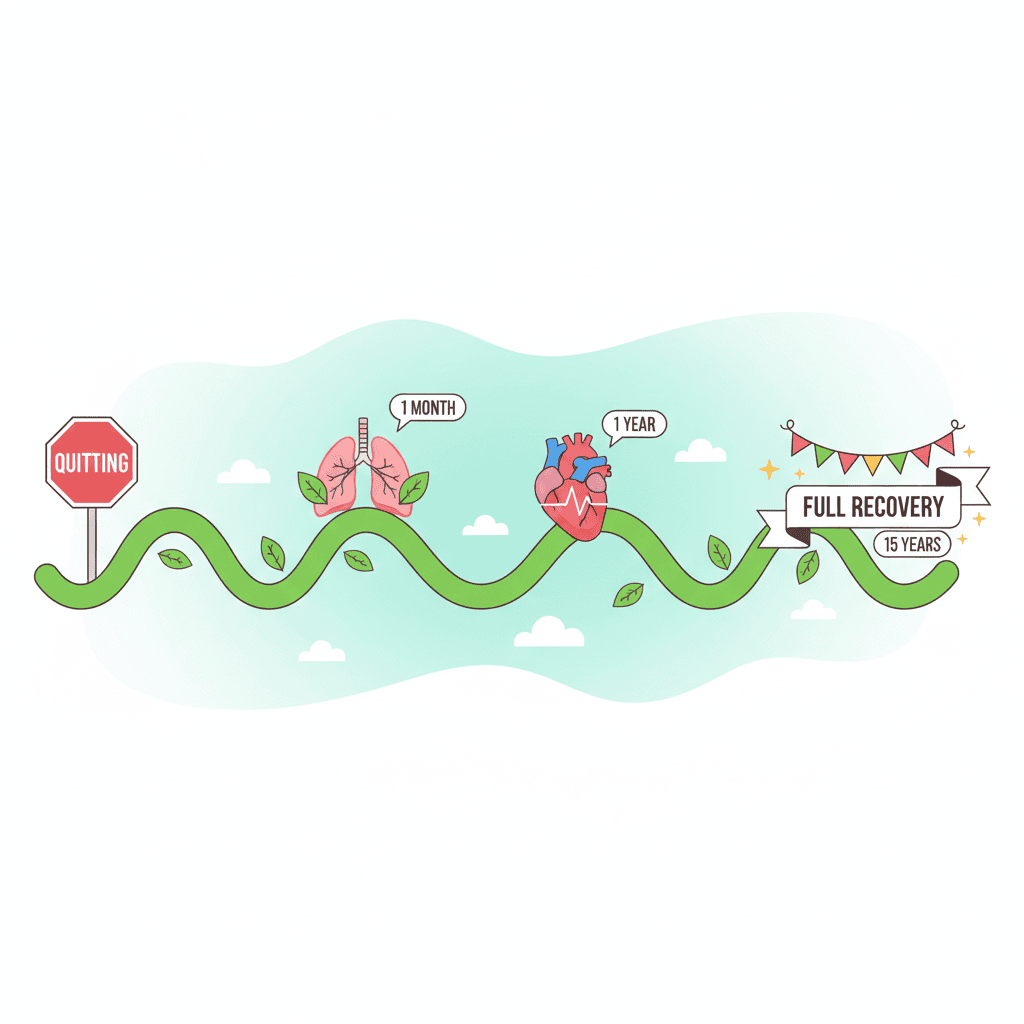
The one-year milestone: After twelve months without tobacco, your risk of coronary heart disease is roughly half that of someone still smoking. That is the headline number from decades of epidemiological research, and it is real. It is not saying you are at the same risk as a non-smoker yet, but you have already cut your excess risk in half in a single year.
What Happens at 5, 10, and 15 Years?
The long arc of cardiovascular recovery stretches well past the first year.
At 5 years: Stroke risk drops to a level close to a non-smoker, according to U.S. Surgeon General reports. Risk of cancers of the mouth, throat, and esophagus also drops by about half.
At 10 years: The risk of dying from coronary heart disease is about half that of someone still smoking, and coronary artery disease progression has slowed substantially. The cumulative effect of a decade of better blood pressure, cholesterol, and inflammation adds up.
At 15 years: The risk of coronary heart disease is essentially the same as a lifelong non-smoker in most large epidemiological studies. Put differently, after 15 years of not smoking, your heart is statistically indistinguishable in cardiovascular risk from someone who never touched a cigarette.
These numbers come from the Surgeon General's Report on smoking cessation and have been replicated in studies from multiple countries. The timeline is remarkably consistent: one year for half the coronary risk, 15 years for full normalization.
What Damage Does Not Fully Reverse?
It would be dishonest to claim that every trace of smoking disappears. Some structural changes, if they were severe enough, stay with you.
Existing atherosclerosis does not vanish. Plaques that have calcified in your arteries remain, though they become more stable and less likely to rupture once you quit. New plaque formation slows dramatically.
Prior cardiac events leave scar tissue that is permanent. A heart that has had a heart attack before quitting carries that scar regardless of how long you stay smoke-free afterward. What quitting does is dramatically reduce the odds of a second event.
Peripheral artery disease, if already established, may progress more slowly after quitting but usually does not fully reverse.
The overwhelming message from cardiology is still the same: the best time to quit was decades ago, and the second-best time is today. Even people who quit after a first heart attack cut their risk of a second one by roughly 30 to 50 percent.
Why Is the First Year So High-Leverage?
Almost all of the major gains happen in the first 12 months. Blood pressure normalizes, inflammation drops, clotting behavior improves, HDL rises, endothelial function recovers, and coronary risk is halved. This is why cardiologists treat the first year after quitting as the highest-leverage medical decision most of their patients will ever make, worth more than any single medication or procedure short of bypass surgery.
It is also why the first year is worth protecting carefully. The two biggest cardiovascular risks in this window are a relapse to smoking, which instantly reactivates the full risk profile, and under-treated blood pressure or cholesterol that your doctor did not recheck after you quit. A post-quit cardiovascular checkup at the three-to-six-month mark is worth scheduling. Many former smokers discover they can safely reduce or stop medications they needed as smokers, because the underlying risk has dropped so much.
If you are using exercise to support your quit, that is one of the smartest things you can do for your heart specifically. See exercise and quitting smoking for how aerobic activity accelerates the cardiovascular recovery timeline.
How Can Smoke Tracker Help You Protect Your Heart Recovery?
The cardiovascular benefits of quitting are real, but they are also invisible on a day-to-day basis. You do not feel your endothelium healing. You do not feel your fibrinogen dropping. What you feel is the urge to smoke, and the moments when staying quit feels harder than it should. The tracker closes that gap.
- Health Timeline: See exactly which cardiovascular milestones you have already hit, from the 20-minute blood pressure drop to the 1-year halving of heart attack risk. Making the invisible recovery visible turns every smoke-free day into measurable progress.
- Streak Counter: The first year is the one that cuts your coronary risk in half. Watching the days stack up turns a statistical finish line into a personal one.
- Craving Log: Spot the moments your heart and nervous system are most likely to push you toward relapse, so you can protect the recovery you have already built.
- Money Saved: Redirect cigarette money toward heart-supporting habits, a gym membership, better food, a cardiologist checkup at six months. Your savings can literally fund your recovery.
Of every organ in your body that heals after your last cigarette, your heart is the one that responds most quickly and most dramatically. Twenty minutes in, it is already recovering. One year in, half your excess risk is gone. Fifteen years in, you are statistically the same as someone who never smoked a day in their life.
Every hour you do not light up is an hour your heart spends rebuilding. The only thing it asks from you is time.
Sources
- U.S. Department of Health and Human Services. "The Health Benefits of Smoking Cessation: A Report of the Surgeon General." surgeongeneral.gov
- Centers for Disease Control and Prevention. "Smoking and Cardiovascular Disease." cdc.gov
- American Heart Association. "How Smoking and Nicotine Damage Your Body." heart.org
- Circulation (AHA Journal). "Smoking Cessation and Cardiovascular Events." ahajournals.org
- National Heart, Lung, and Blood Institute. "Smoking and Your Heart." nhlbi.nih.gov
- Mayo Clinic. "Heart Disease: Prevention." mayoclinic.org
This article is for informational purposes only and does not constitute medical advice. Health information is based on published research from organizations such as the CDC, WHO, and American Lung Association. Always consult a healthcare professional for personalized guidance on smoking cessation.