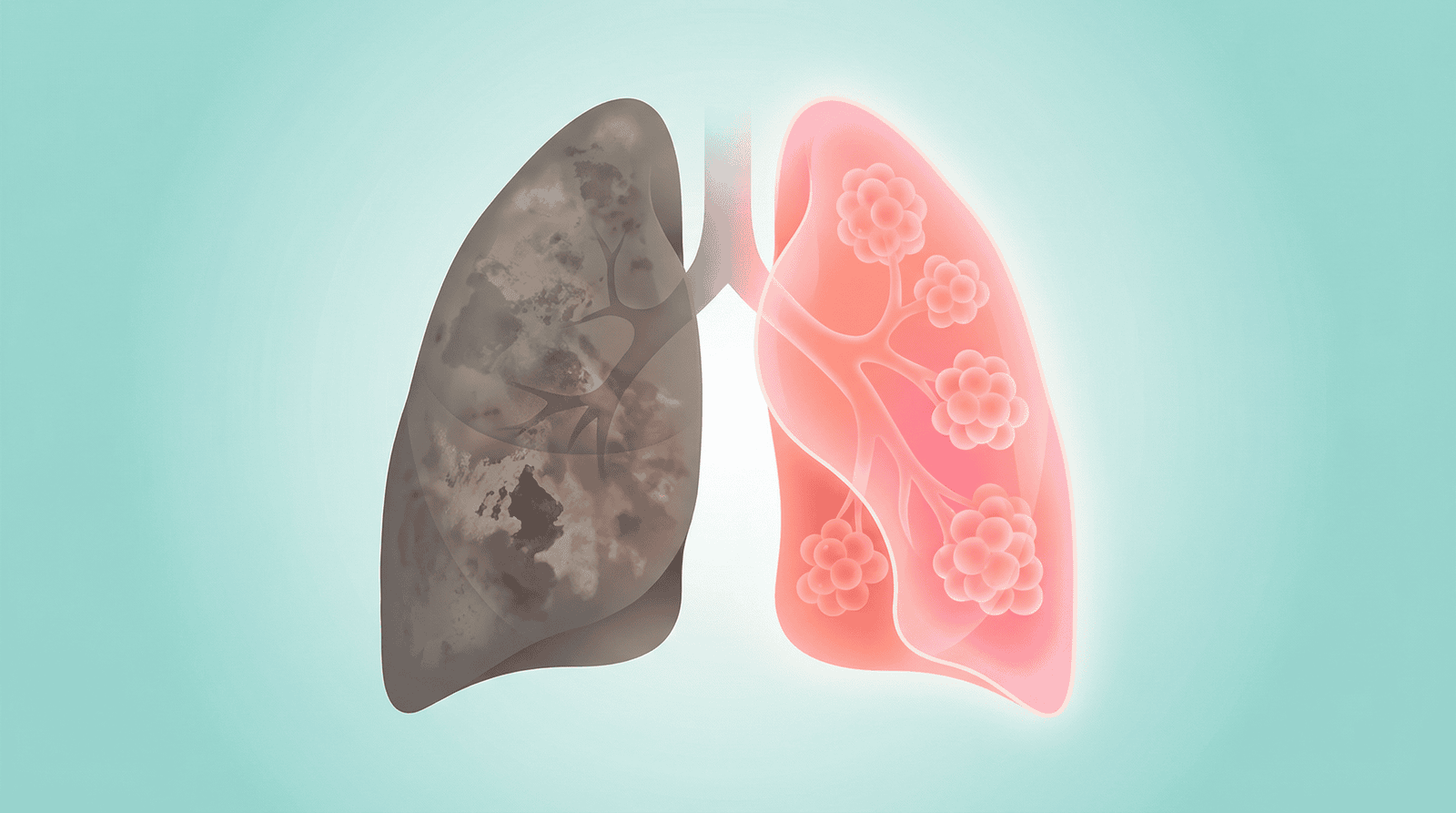
Almost every quitter eventually asks the same private question, usually somewhere around month two. The cravings have eased, the breath is coming back, and a quieter thought surfaces: did I quit in time? Whatever damage is in there from years of smoking, can my body still walk it back? The honest answer, supported by decades of careful epidemiology, is that the cancer risk reduction from quitting is real, large, and continues for the rest of your life. It is also slower and less linear than the cardiovascular benefits, which means the timeline matters. Here is exactly when each cancer risk starts dropping after your last cigarette, when it normalizes, and what does and does not fully reverse, organized so you can locate yourself on the curve.
Why Smoking Causes Cancer in the First Place
To understand what quitting reverses, it helps to understand what smoking actually does at the cellular level. The cancer connection is not abstract or statistical: it is a direct chemical mechanism that has been mapped in detail.
Tobacco smoke contains roughly 7,000 chemicals, of which at least 70 are known carcinogens. The most studied are polycyclic aromatic hydrocarbons (PAHs), tobacco-specific nitrosamines (NNK and NNN), aromatic amines, formaldehyde, benzene, and 1,3-butadiene. When inhaled, these compounds and their metabolites bind directly to DNA, forming chemical adducts that distort the helix and disrupt accurate replication. Each cigarette delivers a small wave of these adducts to the cells lining the airway, the bladder, the kidney, and many other tissues that the bloodstream eventually distributes them to.
Most adducts are repaired by your DNA repair machinery before the cell divides. A small fraction is not. When an unrepaired adduct sits in a critical gene during cell division, the daughter cell can inherit a permanent mutation. Over years of smoking, mutations accumulate, especially in tumor suppressor genes like TP53 and oncogenes like KRAS. Once enough mutations have stacked in the right combinations within a single cell, that cell can escape normal growth controls and become a cancer.
This is why the cancer risk from smoking is dose-related and time-related. The longer you smoke and the more you smoke per day, the more rolls of the dice with mutations. It is also why quitting matters at any age. The instant you stop, you stop adding new adducts, and the long arc of mutation accumulation slows.
What Happens to Cancer Risk in the First Year?
Year one is mostly about the carcinogen exposure stopping rather than visible cancer-risk reduction in the data. The early benefits show up first in the cardiovascular and respiratory systems, and the cancer curves take longer to bend. But several things are already happening underneath.
Carcinogen exposure drops to zero within days. Cotinine, NNAL (a metabolite of the lung carcinogen NNK), and PAH metabolites all clear from the body within roughly 1 to 4 weeks of cessation. The chemical onslaught simply stops. From the perspective of new DNA adduct formation, you are now indistinguishable from a never-smoker.
Cilia regrow and clear accumulated debris. The mucociliary escalator in the airway, which had been paralyzed by smoking, reactivates within 1 to 9 months and starts clearing the residual particulate matter, which is one source of ongoing inflammatory and oxidative stress in lung tissue. For more on this specific recovery process and the productive cough that goes with it, see how lungs heal after quitting smoking.
Inflammation markers fall. Smoking elevates C-reactive protein, white blood cell count, and dozens of inflammatory cytokines. Within months of cessation, these begin falling toward never-smoker baselines. Chronic inflammation is itself a cancer risk factor, and reducing it removes one of the conditions that pushes mutated cells toward malignant transformation.
Risk of mouth and throat cancers begins declining. This is the earliest tissue group to show measurable risk reduction in epidemiological studies, with meaningful drops visible by the end of year one. The oral cavity, larynx, and pharynx are tissues with high direct contact with smoke and relatively high cellular turnover, so they respond quickly.
The shape of year one is "exposure stops, repair starts." The published cancer-risk curves are still mostly flat at this stage, but the underlying biology has already turned the corner.
Years 2 to 5: Mouth, Throat, Esophagus, and Bladder Risks Drop
This is the window where the first big drops start showing up in long-term cohort studies, especially for cancers of the upper aerodigestive tract.
Oral cavity, larynx, and pharynx cancers. By 5 years of abstinence, risk has typically dropped by roughly 50 percent compared to continuing smokers. The American Cancer Society and the Surgeon General's reports both place the major drop in this window, with continued decline thereafter.
Esophageal cancer. Risk declines steadily, with roughly half the excess risk gone by 5 to 10 years. The squamous cell type of esophageal cancer (the one most directly linked to smoking) shows the clearest reduction.
Bladder cancer. This is one of the more striking ones. Smokers have roughly three times the bladder cancer risk of never-smokers, and within 5 years of quitting, that risk drops by about 25 percent. By 10 years, it has dropped further. Bladder cancer risk is one that does not fully normalize, but the partial reduction starts visibly in this window.
Stomach and kidney cancers. Both show measurable risk reduction in this window, though the curves are gentler than for the more directly exposed tissues.
The mechanism behind this faster recovery for upper-tract tissues is twofold. First, these tissues have high cell turnover, which means cells with smoking-induced mutations are continually being replaced by cells dividing under post-quit conditions. Second, the carcinogen exposure that drove their mutation burden has stopped, so the mutational pressure on dividing cells is now zero.
This is also the window where the cardiovascular curve is dropping steeply. By 1 year smoke-free, coronary heart disease risk is roughly half that of a continuing smoker. By 5 years, stroke risk approaches that of a never-smoker. The cardiovascular and cancer curves are running on different clocks, but they are both running. Our piece on heart recovery after quitting smoking covers the cardio side in detail.
Years 5 to 10: Lung Cancer Risk Halves
This is the milestone almost every quitter has heard about, and it is real.
Lung cancer. By 10 years of continuous abstinence, lung cancer death risk drops to roughly half that of a continuing smoker. The exact ratio varies by study and by smoking history, but multiple large cohort studies, including the seminal work by Doll and Peto on British doctors and the U.S. Cancer Prevention Studies, converge on this 50 percent figure. The drop is not linear: most of it happens between years 5 and 10.
Laryngeal and pharyngeal cancers. Continue dropping toward never-smoker levels and approach them by 10 years for many former smokers, though heavy long-term smokers retain some excess risk.
Cervical cancer (in women who smoked). Drops noticeably in this window, since smoking is an HPV cofactor and removing it reduces persistent infection risk.
Acute myeloid leukemia. Risk drops measurably by 10 years, though the absolute risk is small.
The reason lung cancer takes longer to normalize than the upper-tract cancers is that lung tissue, unlike the oral cavity, has lower cellular turnover and a higher accumulated mutational burden after years of direct smoke contact. Some of the cells with the most dangerous mutation combinations are still alive and dividing slowly, and the curve cannot drop faster than the slow dilution and replacement of those cells by ones with cleaner genomes. By 10 years, that dilution has done about half its work. By 15 to 20 years, it has done most of it.
This is the window where many former smokers also start to feel the change rather than just believe it. Breath returns to baseline, exercise tolerance climbs, sleep deepens, and the daily reminder of "I used to smoke" fades into the background. Our smoking cessation timeline post maps the full body-wide trajectory across this stretch.
Years 10 to 20: The Long Recovery
The cancer curves are still bending downward, just more gradually. Some risks normalize fully in this window, some plateau at a level above never-smoker, and the differences are worth knowing.
Lung cancer. Continues dropping. By 15 years smoke-free, lung cancer risk is meaningfully closer to never-smoker levels for moderate former smokers, though heavy long-term smokers retain some excess risk. By 20 to 25 years, the risk for many former smokers is within striking distance of never-smoker baseline.
Pancreatic cancer. This is one of the slower curves. Smokers have roughly twice the risk of never-smokers, and the excess risk takes 10 to 20 years to substantially decline. By 20 years smoke-free, risk approaches never-smoker levels in most studies.
Bladder cancer. Continues declining gradually but does not fully normalize even at 20 years. Former smokers retain some elevated risk for life, particularly heavy long-term smokers. The risk reduction is still substantial, on the order of 60 to 70 percent of the smoker excess gone by 20 years.
Colorectal cancer. A more recently appreciated link. Risk declines after cessation but on a slow timescale similar to pancreatic.
Liver cancer. Risk declines, particularly when combined with reduced alcohol intake.
The general principle is that tissues with high direct smoke exposure (mouth, throat, larynx) recover faster than tissues exposed mainly via the bloodstream (pancreas, bladder, kidney), because the direct-exposure tissues had more concentrated carcinogen contact and also have higher cell turnover that helps clear mutated cells.
What Does Not Fully Reverse?
It is important to be honest about what quitting does and does not undo, because honesty is what makes the rest of the timeline trustworthy.
Lung cancer risk in heavy long-term smokers. Quitting after 30+ years of pack-a-day smoking reduces risk substantially but does not fully normalize it. Excess risk relative to never-smokers persists for life, although the excess is a fraction of what it would have been with continued smoking.
Bladder cancer. Excess risk persists at a reduced level even at 20+ years post-cessation.
COPD-driven cancers. In smokers who have already developed significant COPD, structural lung damage is mostly permanent, and the airway environment retains some of the conditions that increase cancer risk.
Mutations that have already accumulated. Quitting stops new mutations from forming, but it cannot remove the ones already laid down in surviving cells. What it does is dramatically slow the rate of further accumulation and reduce the probability that an already-mutated cell will progress.
Cancers already in motion. Microscopic cancers that have already started forming will continue progressing on their own timeline, although the body's repair and immune systems are now operating in a less inflammatory environment, which can slow some malignancies.
The honest framing is that quitting is the most powerful intervention in cancer prevention available to a current smoker, but it is not a reset button. What it does is take you off the worst trajectory you were on and put you on the best one available from this point forward.
Why Quitting at Any Age Beats Not Quitting
One of the most important findings in modern smoking research is that the benefits of quitting are large at every age, not just for the young.
Doll and Peto's landmark 50-year study of British doctors found that quitting at age 30 avoids almost all of the excess mortality risk from smoking. Quitting at 40 still avoids about 90 percent of it. Quitting at 50 cuts the risk roughly in half. Quitting at 60 still produces meaningful gains in life expectancy, on the order of 3 years on average. The Million Women Study published in 2013 found very similar numbers for women.
This matters because many older smokers conclude that the damage is done and quitting at this point will not help. The data is unambiguous that this is wrong. Even quitting in your 60s and 70s reduces cancer risk, slows the rate of cardiovascular decline, and improves both quality and length of life. The cancer risk curves continue to bend downward at every age of cessation. The body never stops responding to the absence of carcinogens.
There is also a related point worth making. The cancer risk reduction is partial in a way that the cardiovascular risk reduction is not. Coronary heart disease risk normalizes essentially completely within 15 years for most quitters. Lung cancer risk does not fully normalize for heavy long-term smokers. But "does not fully normalize" is not the same as "does not improve." The improvement is large, real, and continues for decades, and it is one of the highest-leverage health choices any person can make at any age.
How the Cancer Recovery Compares to Other Recoveries
It is useful to put cancer risk reduction in the context of the other body-wide recoveries you read about.
The fastest recoveries are cardiovascular. Coronary heart disease risk halves in the first year and approaches non-smoker by 15 years. Stroke risk normalizes within 5 to 15 years.
The middle-paced recoveries are organ-level: lungs (most function returns by 9 to 12 months), brain (receptors normalize by 3 months, gray matter by 1 to 2 years), and senses (taste and smell improve within weeks, full recovery within months).
The slowest recoveries are cancer-related, because cancer risk depends on the slow turnover and replacement of cells carrying mutational burden. Most cancer-risk curves take 10 to 20 years to do most of their bending.
This is why the cancer benefit is the one most often underappreciated by quitters in the first year, and the one that most rewards long-term abstinence. Years 5, 10, and 20 are not just arbitrary milestones. They are inflection points on the cancer-risk curve where most of the reduction is happening.
How Can Smoke Tracker Help You Stay on the Curve?
The cancer risk curve is invisible from day to day, which is part of what makes long-term abstinence hard to feel rewarded for. The tracker is built to make the slow recoveries legible.
- Streak Counter: Cancer risk reduction depends entirely on continuous abstinence. Every uninterrupted day on the counter is another day of cells dividing under non-smoker conditions, replacing carriers of smoking-induced mutations.
- Health Timeline: See exactly which cancer-risk milestones you have already crossed, from the first-year inflammation drop to the 5-year throat-cancer halving to the 10-year lung-cancer halving. Watching the science unfold in real time makes the long arc of recovery feel like progress instead of a vague hope.
- Money Saved: Years of cancer-risk reduction also accumulate substantial savings. Use them on something that benefits the new, lower-risk version of you, like a screening you have been putting off, a fitness investment, or a trip you would not have planned as a smoker.
- Craving Log: The cravings that show up in years 1, 2, and 3 are the ones standing between you and the steepest part of the cancer-risk curve. Logging them pattern-matches the moments when relapse becomes likely so you can recognize them in advance.
For the moments when stress, social pressure, or anxiety surface a craving years into your quit, slow paced breathing can shift the autonomic system out of fight-or-flight in about 90 seconds and is one of the fastest ways to disarm a relapse cue without waiting for the urge to pass on its own. We built Flow Breath for exactly that kind of short, situational regulation, and it pairs particularly well with the long maintenance phase of quitting where the chemistry has settled but old cues still occasionally fire.
The cancer risk timeline is the longest of any recovery in your body, and it is also the most rewarding to keep going on. The curve you are on right now, every day, is not the smoker curve. It is the bending one.
Every cigarette you do not smoke today is a smaller stack of mutations tomorrow. The math of the curve is already on your side.
Sources
- U.S. Department of Health and Human Services. (2020). "Smoking Cessation: A Report of the Surgeon General." ncbi.nlm.nih.gov
- Doll, R., Peto, R., Boreham, J., and Sutherland, I. (2004). "Mortality in relation to smoking: 50 years' observations on male British doctors." BMJ. pubmed.ncbi.nlm.nih.gov
- Pirie, K., et al. (2013). "The 21st century hazards of smoking and benefits of stopping: a prospective study of one million women in the UK." The Lancet. pubmed.ncbi.nlm.nih.gov
- American Cancer Society. "Health Benefits of Quitting Smoking Over Time." cancer.org
- Hecht, S. S. (2003). "Tobacco carcinogens, their biomarkers and tobacco-induced cancer." Nature Reviews Cancer. pubmed.ncbi.nlm.nih.gov
- International Agency for Research on Cancer (IARC). "Tobacco Smoke and Involuntary Smoking." IARC Monographs Volume 83. iarc.who.int
- Centers for Disease Control and Prevention. "Benefits of Quitting Smoking." cdc.gov
- National Cancer Institute. "Harms of Cigarette Smoking and Health Benefits of Quitting." cancer.gov
Common questions
- How long until lung cancer risk returns to normal after quitting?
- Lung cancer risk drops by 50 percent over 10 years smoke-free compared to continued smoking. It continues falling and approaches non-smoker levels around 15 to 20 years after quitting. The risk never reaches zero, but the curve flattens and lung cancer becomes a small risk rather than a large one.
- Does cancer risk ever return to never-smoker levels?
- For some cancers, yes. Mouth, throat, and esophageal cancer risk halves within 5 years and approaches never-smoker levels by 10 to 15 years. Lung cancer risk approaches but never quite matches never-smoker levels. Bladder, cervical, and pancreatic cancers also fall measurably but on different timelines.
- When does mouth and throat cancer risk drop after quitting smoking?
- Mouth, throat, larynx, and esophageal cancer risk halves within 5 years of quitting. Bladder cancer risk also halves at 5 years. By 10 to 20 years smoke-free, these cancers approach the risk level of someone who never smoked. The first 5 years deliver the steepest decline.
- Does quitting at any age reduce cancer risk?
- Yes. The relative risk reduction is consistent at any age, although the absolute years gained are larger if you quit earlier. Even quitting after a cancer diagnosis improves treatment outcomes and reduces recurrence risk. The benefit of quitting on cancer never disappears.
This article is for informational purposes only and does not constitute medical advice. Health information is based on published research from organizations such as the CDC, WHO, and American Lung Association. Always consult a healthcare professional for personalized guidance on smoking cessation.