The test is positive, and the next thought is often not joy. It is the cigarette you had this morning, the ones you meant to stop "before trying," and a search at 1 a.m. for whether it is already too late. Shame is loud here, and it is a terrible quit plan. It delays the only thing that changes the baby's exposure: the next cigarette not happening. You do not need a perfect origin story. You need a method that is actually allowed in pregnancy, a clear answer to the cold-turkey scare, and a way through the first few days. Here is that plan.
It Is Not Too Late, Even This Week
CDC is blunt: the best time to quit is before pregnancy, and quitting at any time during pregnancy still helps. ACOG says the same in its 2020 committee opinion: smoking cessation at any point in gestation benefits the pregnant woman and her fetus, with the greatest overall benefit before 15 weeks. Separately, CDC says stopping early in pregnancy can eliminate smoking's adverse effect on fetal growth. If you stop later, you still end the ongoing smoke exposure.
What changes fast is oxygen. Carbon monoxide from smoke reduces the oxygen reaching the baby. CDC's pregnancy guidance notes that the baby gets more oxygen even after one day smoke-free. Quitting also supports healthier growth and lowers the chances of preterm birth and stillbirth, which is why "I will quit next month" is an expensive delay and "I will quit this week" is not.
None of this requires you to feel proud yet. It requires a quit date, which for a pregnancy is today or the soonest morning you can clear the house, not a date after the anatomy scan.
What Smoking Is Doing That Cigarettes Hide
A cigarette is not "just nicotine." Much of smoking's harm comes from components of tobacco smoke other than nicotine, including carbon monoxide and thousands of chemicals. Nicotine itself crosses the placenta and also carries fetal risk. ACOG lists the perinatal risks clinicians are supposed to name out loud: fetal growth restriction, low birth weight, preterm prelabor rupture of membranes, placenta previa, placental abruption, orofacial clefts, increased perinatal mortality, ectopic pregnancy, and reduced maternal thyroid function. CDC adds stillbirth and a higher risk of SIDS after birth. Children of people who smoked in pregnancy also carry extra risk of respiratory infections, asthma, and childhood obesity.
That list is why the "I only smoke a few a day" bargain fails. There is no established safe threshold of cigarette smoke in pregnancy. If you cut down, keep moving toward stopping completely: ACOG says the benefits of reduction are difficult to quantify, and quitting outright best affects long-term health. Light smoking in the first trimester is still smoking. If you want the general, non-pregnancy version of a quit plan, the step-by-step guide to how to quit smoking is the sibling piece. The rules below are the pregnancy overlay: what you can use, what you should not, and which internet myths to ignore.
Guidance Does Not Link Abrupt Quitting to Miscarriage
This is the question under most of the delay. People have heard, or have told themselves, that quitting suddenly shocks the baby, raises miscarriage risk, or should wait until after the first trimester so withdrawal does not "stress" the pregnancy.
Nicotine withdrawal is temporary and can cause restlessness, irritability, sleep problems, hunger, and cravings. Symptoms are often strongest in the first few days or weeks and then weaken over time. It is unpleasant, but Smokefree.gov describes it as not harmful and says quitting does not put extra stress on the baby. Smoking during pregnancy, by contrast, is associated with miscarriage, ectopic pregnancy, stillbirth, and placental abruption, which is why the guidance says to stop as soon as you can.
The USPSTF gives behavioral interventions in pregnancy an A grade. Current NICE guidance recommends intensive behavioral support and says NRT can be considered alongside it from the earliest opportunity. The shared first step is supported cessation, not a test of willpower.
Trying without medication does not mean white-knuckling in a house full of cigarettes, skipping prenatal care, or refusing help. If you are still smoking despite support, or your clinician recommends NRT earlier, discuss it then. Do not postpone quitting until after the birth while continuing to smoke through the remaining weeks.
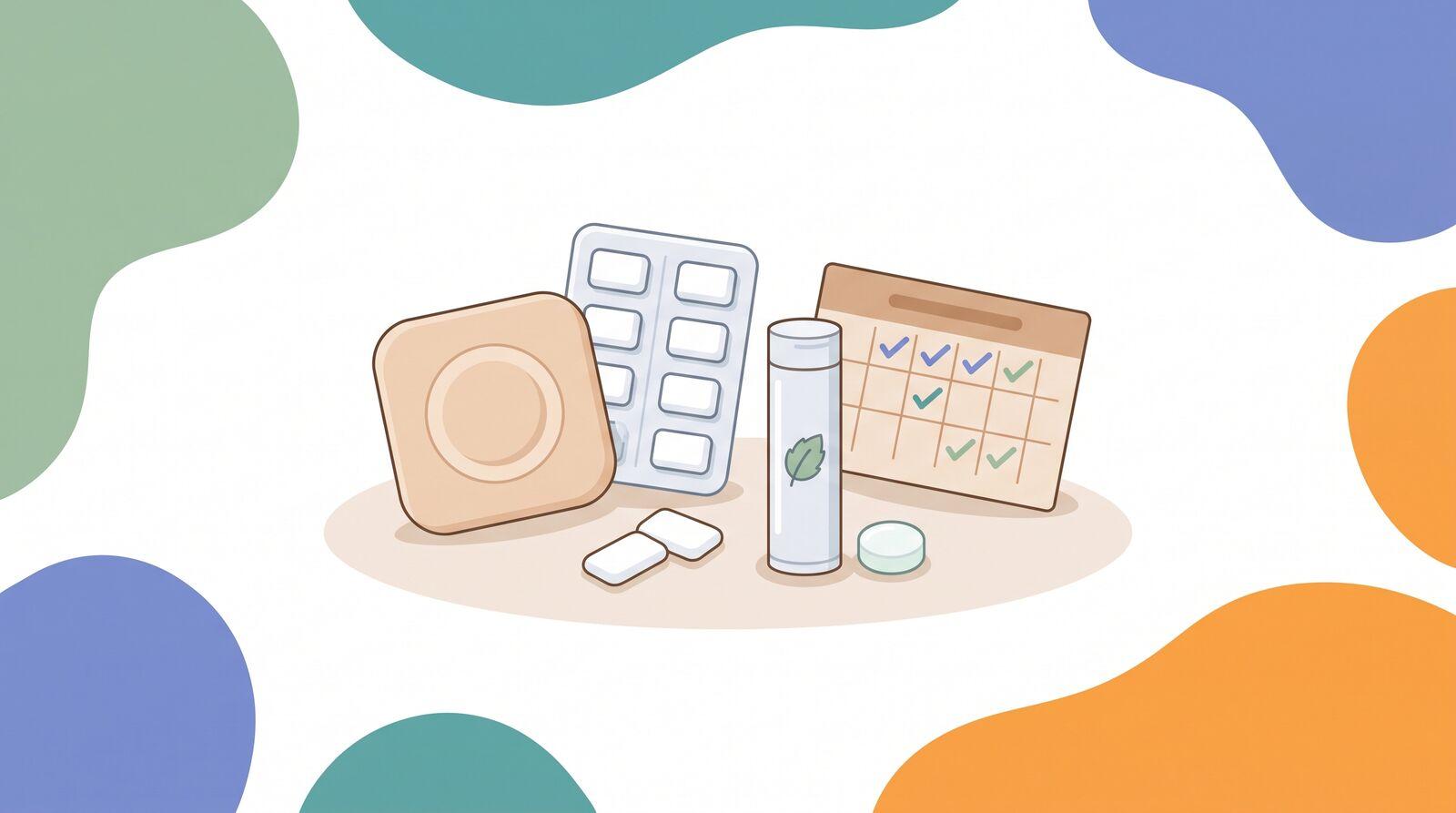
NRT With Professional Support
Nicotine replacement is the awkward middle of pregnancy advice, and the honest version is split by country.
- United States: The USPSTF says evidence is insufficient to balance benefits and harms of pharmacotherapy for pregnant people, so counseling leads. It advises case-by-case shared decision-making based on tobacco-dependence severity. ACOG says NRT should be considered only after a detailed discussion of the known risks of smoking, the possible risks of NRT, and the need for close supervision.
- United Kingdom: NICE says to consider NRT alongside behavioral support at the earliest opportunity in pregnancy. NHS lists patches, gum, lozenges, and several other forms. Stop-smoking medicines cytisinicline, varenicline, and bupropion are not offered. Patches should be removed at bedtime. Combination NRT is more effective than one form in general cessation care; the pregnancy plan and dose still need professional guidance.
A 2020 Cochrane review found low-certainty evidence that NRT plus behavioral support may raise quit rates in late pregnancy versus support alone. For miscarriage, stillbirth, preterm birth, birth weight, and neonatal death, it found insufficient evidence to determine benefit or harm. That does not prove NRT harmless; UK guidance nevertheless judges its risks much lower than continued smoking.
Practical rules if your obstetrician or midwife agrees on NRT:
- Use NRT with behavioral support and professional guidance. NICE says it can be considered from the earliest opportunity in pregnancy; US guidance uses case-by-case shared decision-making.
- Use the advised dose correctly and make sure it is high enough to control cravings and prevent compensatory smoking. The patch, gum, and lozenge guide explains technique; pregnancy changes who helps select the product and dose.
- Take patches off at night unless your clinician says otherwise.
- If you smoke or vape while using NRT, tell your clinician or adviser so they can adjust the plan. Do not change or combine products on your own.
- Tell every clinician you see, including the emergency department, that you are using NRT.
NRT delivers nicotine without the many harmful smoke chemicals. UK guidance says its risks are much lower than smoking, though nicotine exposure is not risk-free. Pregnancy is not the time to improvise the product or dose.
What Not to Start on Your Own
Cytisinicline (cytisine), varenicline (Chantix), and bupropion (Zyban). NICE says not to offer any of them during pregnancy. The USPSTF identified no pregnancy cessation trials of varenicline or bupropion, while ACOG notes limited data on those two drugs and says clinicians may discuss their use. Do not borrow a leftover pack or start a pill because it worked for a friend. If you were already taking one when you found out you were pregnant, contact the prescriber promptly rather than guessing whether to stop. The Chantix vs Zyban explainer is useful context for non-pregnant use. It is not a pregnancy protocol.
E-cigarettes and vapes. US guidance advises stopping them during pregnancy: nicotine crosses the placenta, and aerosols can contain flavorants, solvents, metals, and other compounds. UK guidance is different. NICE recommends considering licensed NRT, while NHS says vaping, though not risk-free, is much safer than continued smoking if it enables you to stop cigarettes. Switching from smoking to vaping should therefore be discussed with a prenatal clinician or stop-smoking adviser. Dual use continues cigarette-smoke exposure.
Nicotine pouches, snus, and dip. These products deliver nicotine without combustion, but nicotine crosses the placenta and they are not licensed cessation medicines. If smokeless tobacco is the habit, say so at prenatal visits. Do not switch from cigarettes to Zyn without clinical advice and call it equivalent to NRT.
"Natural" quit products. Herbal cigarettes, detox teas, high-dose supplements, and essential-oil gadgets are not included in the pregnancy cessation guidance reviewed here. Do not use them without asking a prenatal clinician or pharmacist. Behavioral support and a professionally guided NRT conversation are the evidence-based options. Our natural remedies piece is a fact-check, not a shopping list for a pregnant person.
A Two-Week Plan You Can Start This Week
Treat this like a medical protocol, not a New Year's resolution.
Day 0 (today or tomorrow morning)
- Tell your obstetrician, midwife, or prenatal clinic you smoke and you are quitting. Ask for referral to counseling or a quitline. In the US, 1-800-QUIT-NOW and Smokefree.gov's pregnancy pages are the public starting points. In the UK, NHS Stop Smoking Services are built for this.
- Throw out cigarettes, lighters, and ashtrays in the house, car, and bag. A hidden pack is not a safety net. It is the relapse.
- Pick substitutes that are boring and allowed: water, sugar-free gum, sunflower seeds, a toothbrush, a short walk. Stock them before the first craving, not during it.
Days 1 to 3
- Withdrawal is often strongest in the first few days. Expect irritability, sleep problems, and frequent cravings. They pass. The 4 Ds can help: delay, drink water, deep-breathe, distract.
- Eat on a schedule. Hunger plus withdrawal feels like a cigarette emergency.
- Keep prenatal appointments. Carbon monoxide monitoring, if your clinic does it, is information, not a test you can fail.
- Sleep may be worse before it is better. That can be withdrawal plus pregnancy, not a sign you should smoke to "calm down."
Days 4 to 14
- Cravings may begin to space out. Triggers do not: coffee, the car, stress, other smokers. Change the first ten minutes of those routines.
- If you are still smoking despite support, contact your clinician or adviser now. That is a prompt to adjust the plan, which may include NRT, not proof you "can't quit pregnant."
- Move every day if your clinician has not restricted activity. A short walk can help with withdrawal-related restlessness and provide a distraction.
A slow-breathing reset is one nicotine-free way to occupy yourself while a craving passes. Companion apps such as Flow Breath provide something structured to do during that window.
If you slip, do not write off the pregnancy. One cigarette is a lapse. A pack a day from tomorrow is a relapse. Note the trigger, throw out whatever is left, and continue from the same quit. The relapse guide is the longer version of that distinction.
The House, the Partner, the Car
You can quit in a household that still smokes. It is harder, and the baby still lives in that air.
Secondhand smoke in pregnancy is linked to small reductions in birth weight. After birth, it raises the infant's risk of SIDS, middle-ear disease, and lower respiratory illness. That is CDC, not etiquette.
Ask for three concrete rules, not a personality change:
- No smoking inside the home or the car, ever.
- Outdoor smoking only, well away from the pregnant person and, after birth, from the baby.
- A quit date of their own, or a referral, if they will take one. The piece on supporting a partner who is quitting flips: you can hand it to them.
If they refuse, keep the rules anyway. Protecting the air is part of prenatal care. It is not overreach.
After the Birth, the Quit Is Not Automatic
A large share of people who stop during pregnancy smoke again in the months after delivery. The motivation that was organized around the baby has to be rebuilt around sleep deprivation, stress, and a social world that still smokes. Plan for that now, while the reason is loud:
- Keep the same smoke-free house rules after you come home.
- If you used NRT, ask before the due date whether to continue it after delivery. NICE says it can continue if needed to prevent relapse.
- Breastfeeding and nicotine is a separate conversation with your clinician. Smoking while breastfeeding can expose the baby to nicotine and other harmful substances through breast milk and to secondhand smoke.
- The long-game stay-quit plan is the document to reopen at week six postpartum, not a new decision made at 3 a.m. with a crying newborn.
Quitting for the pregnancy and staying quit for the child are two jobs. The first one is this week's.
How Can Smoke Tracker Help During Pregnancy?
The app is not prenatal care and it is not a substitute for your obstetrician. It is a way to keep the days visible when withdrawal and nausea are both lying to you.
- Streak counter: Days 1 to 3 are when a number you refuse to reset does more work than a lecture.
- Craving log: Pregnancy has a short list of high-risk cues (car, coffee, other smokers, vomiting-and-then-a-cigarette). Logging them once makes the second time obvious.
- Health timeline and money saved: Abstract fetal benefits are hard to feel. A running tally is not, and it is a reminder on the afternoon the shame gets loud again.
Use it next to, not instead of, the quitline and the prenatal clinic. If NRT is in the plan, log that you are using it so a hard day does not look like "nothing is working."
Stopping this week still changes what the baby is exposed to tomorrow. Guidance does not identify abrupt quitting as a miscarriage risk, and behavioral support should start now. US medication decisions are individualized, and NICE considers NRT alongside support early. US guidance advises against vaping, while NHS says vaping is much safer than continued smoking if it fully replaces cigarettes. Clear the cigarettes, tell your prenatal clinician, and plan support for the first few days.
This article is for general educational purposes and is not medical advice. Pregnancy and nicotine involve real clinical decisions. Talk to your obstetrician, midwife, or another qualified prenatal clinician before starting, stopping, or combining any nicotine product or quit-smoking medication, and seek urgent care for bleeding, severe pain, or any symptom that worries you.
Sources
- American College of Obstetricians and Gynecologists. Committee Opinion No. 807. "Tobacco and Nicotine Cessation During Pregnancy." 2020. acog.org
- Centers for Disease Control and Prevention. "Smoking, Pregnancy, and Babies." cdc.gov
- Centers for Disease Control and Prevention. "Maternal and Infant Care Settings and Smoking Cessation." cdc.gov
- NHS. "Stop smoking in pregnancy." nhs.uk
- U.S. Preventive Services Task Force. "Tobacco Smoking Cessation in Adults, Including Pregnant Persons: Interventions." 2021. uspreventiveservicestaskforce.org
- Claire, R., et al. "Pharmacological interventions for promoting smoking cessation during pregnancy." Cochrane Database of Systematic Reviews, 2020. cochrane.org
- National Cancer Institute (Smokefree.gov). "Myths About Smoking During Pregnancy", "How to Quit Smoking While Pregnant", "Managing Nicotine Withdrawal", "How Smoking Affects Your Baby's Health", and "Staying Smokefree After Giving Birth".
- NICE. "Treating tobacco dependence during pregnancy and in the first year after childbirth." 2021, updated 2025. nice.org.uk
Common questions
- Is it safe to quit smoking cold turkey while pregnant?
- Yes. Major guidance recommends stopping as soon as possible and does not identify abrupt cessation as a miscarriage risk. Smokefree.gov says quitting does not put extra stress on the baby. But 'cold turkey' should not mean no preparation or support. Nicotine withdrawal can cause irritability, restlessness, sleep problems, and cravings; it is uncomfortable but not harmful, and symptoms are often strongest in the first few days or weeks. The established pregnancy risks (growth restriction, preterm birth, stillbirth, placental problems, and SIDS after birth) are linked to continuing to smoke, not stopping. If you are still smoking despite support, ask a qualified clinician or stop-smoking adviser about NRT rather than return to cigarettes.
- Is it too late to quit if I am already 7 weeks pregnant?
- No. CDC is explicit that quitting at any time during pregnancy helps, and ACOG says the same: cessation at any point in gestation benefits the pregnant woman and the fetus. ACOG says the greatest overall benefit occurs before 15 weeks; separately, CDC says stopping early in pregnancy can eliminate smoking's adverse effect on fetal growth. After that, the baby still gets more oxygen after one smoke-free day, and quitting still supports healthier growth and lowers the chances of preterm birth. Seven weeks is early. The third trimester is not 'too late' either. The cigarette you do not smoke today is one less exposure today.
- Can I use nicotine patches or gum while pregnant?
- Sometimes, with qualified guidance rather than as a pharmacy experiment. US Preventive Services Task Force evidence on pharmacotherapy in pregnancy is insufficient, so US care prioritizes counseling and shared decision-making. Current NICE guidance says to consider NRT alongside behavioral support at the earliest opportunity in pregnancy. NHS lists patches, gum, and lozenges and advises removing patches at bedtime. Low-certainty trials have not shown a clear difference in adverse birth outcomes, but that is not proof of zero risk. Combination NRT works best outside pregnancy; whether to use it and at what dose during pregnancy is an individual decision. Speak with a prenatal clinician, pharmacist, or stop-smoking adviser before starting, changing, or combining nicotine products.
- Can quitting smoking while pregnant cause a miscarriage?
- Smoking during pregnancy is associated with miscarriage, ectopic pregnancy, stillbirth, and placental abruption. Stopping is not. Smokefree.gov says quitting does not put extra stress on the baby and describes nicotine withdrawal as uncomfortable but not harmful. If you have bleeding, severe pain, or any symptom that worries you, call your clinician: that needs obstetric care. The evidence-based move for the pregnancy is to stop smoking as soon as you can, with support.
- What if my partner still smokes?
- Secondhand smoke during pregnancy is linked to small reductions in birth weight, and after birth it raises the baby's risk of SIDS, ear infections, and respiratory illness. You cannot control another adult's addiction, but you can change the air the baby is in: no smoking in the home or car, outdoor smoking only and well away from you during pregnancy and from the baby after birth, plus a direct request that they quit with you or keep smoke out of shared air. If they will not quit, protect the environment anyway. A one-person quit in a household where someone else smokes is still worth doing.
This article is for informational purposes only and does not constitute medical advice. Health information is based on published research from organizations such as the CDC, WHO, and American Lung Association. Always consult a healthcare professional for personalized guidance on smoking cessation.