You have decided you want to stop, which is the hard part most people never reach. But quitting a vape is its own problem, different from quitting cigarettes in ways that catch people off guard. There is no pack to run out, no ashtray to throw away, no smell on your clothes to remind you what you are doing. The device fits in a pocket, makes almost no sound, and is available every single minute of the day. That convenience is exactly what makes it so sticky, and it is why a lot of committed quitters who handled cigarettes find the vape harder to put down. Here is a step-by-step plan that accounts for what makes vaping specifically difficult, plus what to expect from the withdrawal and how to get through the first two weeks.
Why Vaping Is Harder to Quit Than You Expect
Vaping and smoking deliver the same drug, but the delivery shapes the habit, and the vape's shape is built to keep you using.
The biggest difference is that a cigarette ends and a vape does not. A cigarette burns down in five to seven minutes and forces a stop, which paces your nicotine intake into discrete events you can count. A vape has no stopping cue. You take one puff, put it down, take another two minutes later, and repeat that hundreds of times a day without ever registering it as "a session." The nicotine level in your blood never fully falls, so you stay topped up around the clock and the habit attaches to every micro-moment: every notification, every red light, every pause between sentences.
The second difference is nicotine salts. Most modern disposables and pods use nicotine-salt e-liquid, often at 5 percent strength, which is roughly 50 mg/mL. Salts are smoother than the freebase nicotine in cigarettes, so they go down without the harsh throat hit that naturally limits how much you inhale. The result is that pod users frequently take in far more nicotine than a pack-a-day smoker without it ever feeling like much. A single high-capacity disposable can hold the nicotine equivalent of several packs of cigarettes. Heavier dependence means a steeper withdrawal, which is worth knowing going in so the first days do not surprise you. The full comparison of what vaping actually does to the body is covered in our piece on vaping versus smoking.
The third is that the vape is invisible and always present. There is no social friction, no stepping outside, no lingering smell. That removes all the natural braking points that used to interrupt a smoker, and it means the device is woven into contexts a cigarette never reached: in bed, at your desk, mid-conversation, in the shower for some people. More contexts means more conditioned triggers to unlearn later.
None of this means vaping is harder to quit in some permanent sense. It means the plan has to target the grazing pattern and the constant availability directly, which is what the steps below do.
Step 1: Pick a Quit Date and Set Up for It
Choose a specific quit day within the next two weeks. Soon enough that you do not lose momentum, far enough that you can prepare. Avoid landing it on a day you already know will be high-stress, but do not wait for a magically calm week that never comes.
Then prepare for it concretely:
- Decide your method now, cold turkey or taper (covered in the next step), so day one is not a decision.
- Remove every device and pod the night before. All of them, from your home, your car, your bag, your desk drawer. A vape you can reach in ten seconds during a craving is the single biggest predictor of relapse. The convenience that hooked you works in reverse: make it genuinely inconvenient.
- Tell one or two people. A quiet quit is easy to abandon because no one notices. One person who knows your quit date adds just enough accountability.
- Stock your substitutes before the day, not during the first craving: sugar-free gum, a water bottle, sunflower seeds, a fidget object for your hands, and any nicotine replacement you plan to use.
Step 2: Choose Cold Turkey or a Strength Taper
Both routes work. Pick the one that fits how you actually use the vape.
Cold turkey means stopping completely on your quit date. The withdrawal is concentrated into one sharp window that peaks in days and is mostly over in two weeks. This suits people who graze constantly and cannot pace themselves, because for a grazer there is no stable "less" to hold at, only all or nothing. It is the cleaner break and, for many, the easier one psychologically because there is no daily negotiation.
Tapering means stepping your nicotine strength down over a few weeks, which is uniquely practical with a refillable device. A typical ladder is 50 mg/mL down to 35, then 20, then 10, then 0, spending three to five days at each rung. This softens the withdrawal curve and suits people who find an abrupt stop overwhelming. The one rule that makes or breaks a taper: every step needs a fixed end date. A taper without deadlines is just vaping with extra steps, and it stalls at whatever strength feels comfortable. Write the dates down before you start.
If you use disposables and cannot easily change strength, your taper options are limited, which often makes cold turkey the more honest choice. For the underlying question of why abrupt quitting can actually be easier on the brain's reward system, our piece on the dopamine detox of quitting explains what is happening to your reward circuitry either way.
Step 3: Use Nicotine Replacement to Flatten the Curve
Nicotine replacement therapy is not just for cigarettes. It works for any nicotine dependence, vaping included, and for heavy pod users it is often the difference between a quit that holds and one that does not.
The standard combination is a long-acting patch plus a fast-acting product. The patch delivers a steady baseline of nicotine through the skin that raises the floor of your withdrawal, so the lows are less brutal. The gum or lozenge handles breakthrough cravings, the sharp spikes that the patch alone does not cover. Match the patch strength to how much you were vaping: heavy all-day pod use generally calls for the highest patch dose to start, then a step-down over several weeks. A pharmacist can size this for you in two minutes, and it is worth asking rather than guessing, because under-dosing NRT is a common reason people conclude "it did not work."
NRT is not the only path, and people quit cold turkey without it every day. But if previous attempts collapsed in the first week, adding properly dosed replacement is the highest-leverage change you can make.
What the Vaping Withdrawal Timeline Looks Like
The chemistry is the same as quitting cigarettes, so the curve is too.
Hours 4 to 24. Nicotine clears. First signs are restlessness, irritability, and the reflexive reach for a device that is no longer there. The hand-to-mouth habit is loud here precisely because vaping happened so many times a day.
Days 1 to 3. The peak. Cravings, irritability, difficulty concentrating, and low mood are at their worst. Heavy salt-pod users tend to feel this window harder because their intake was higher than they realized. This is the stretch to plan the lightest possible schedule around.
Days 3 to 14. Decline. Acute withdrawal eases, sleep and concentration start to recover, and the constant craving becomes intermittent. Cravings now cluster around specific triggers rather than running all day.
Weeks 2 to 4. Most physical withdrawal resolves. What remains is mainly the conditioned habit: the urge to puff at your desk, in the car, during a screen break.
Weeks 4 to 8. Situational cravings keep fading. Each trigger you ride out without vaping weakens the association, and by the two-month mark most are quiet.
Step 4: Break the Grazing Triggers
This is the step that matters most for vaping specifically, because the all-day grazing means you built more triggers than a smoker ever did. After the chemical withdrawal fades, these conditioned cues are what drive relapse.
Map your top triggers and pre-decide a response for each:
- Phone and screen time. If you vaped every time you picked up your phone, that pairing is deep. Keep your hands busy with something else during scrolling, or take screen breaks somewhere you never vaped.
- The car. A classic vaping context because it is private and boring. Stock gum in the car and try a podcast or a call to occupy the same mental slot.
- Stress and overwhelm. This is the one people most fear losing, and the relief was always nicotine ending its own withdrawal, not solving the stress. A 90-second breathing reset does the actual nervous-system work a puff was getting credit for. Our companion app Flow Breath is built for exactly those short, situational moments and pairs well with the first two weeks, when cravings and stress spike together.
- Boredom and transitions. The gaps between tasks were prime vaping moments. Have a default action ready: water, a short walk, a stretch, anything that fills the pause.
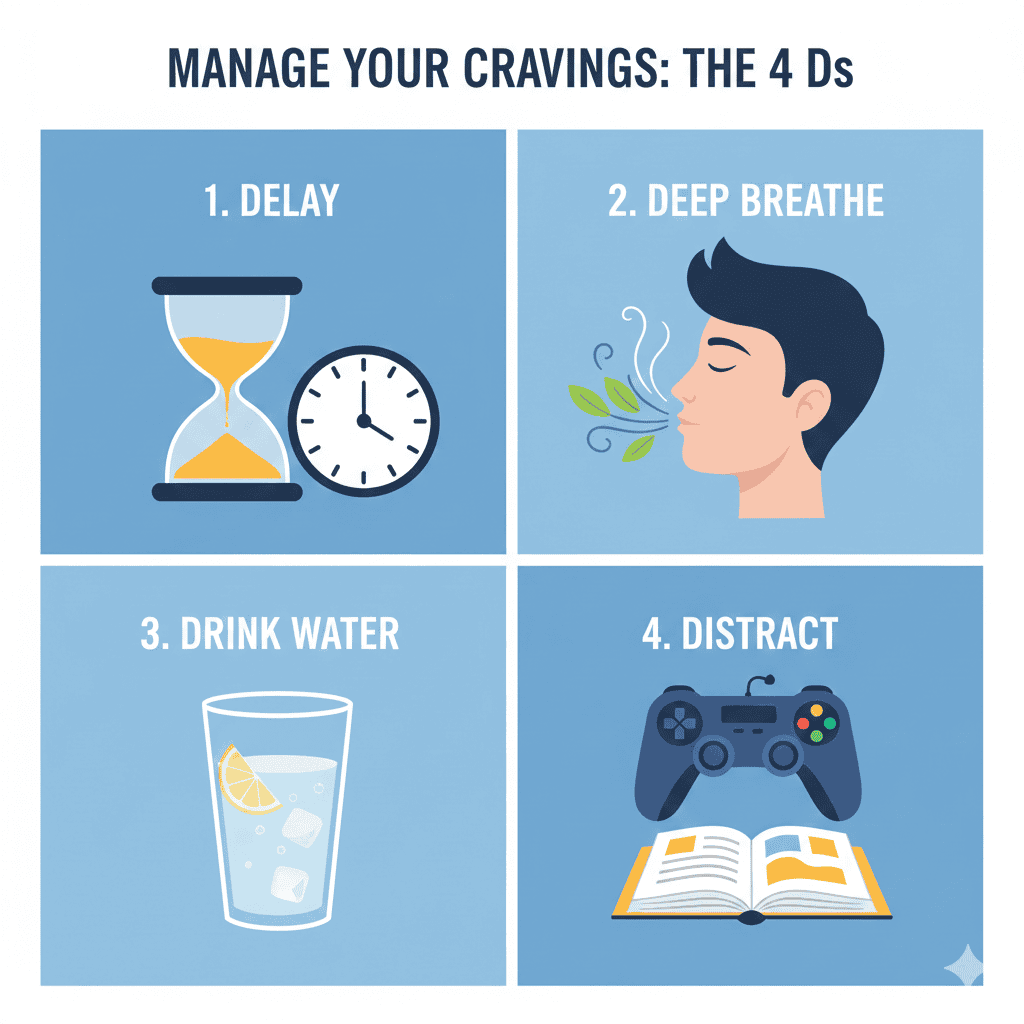
The general craving-management toolkit applies here too. Our guide to managing nicotine cravings covers the delay-distract-decide approach and the surf-the-urge technique in detail, both of which work whether the nicotine came from a cigarette or a pod.
Step 5: Protect the First Two Weeks
The peak window is short, so the goal is to get through it with the fewest excuses to relapse.
- Lower the bar deliberately. Treat days 1 to 5 like recovery from a minor illness. Front-load nothing optional and do not test your willpower in high-risk settings you can simply skip for a week.
- Move every day. Twenty minutes of walking blunts cravings in the moment, lifts the flat low-dopamine mood of early withdrawal, and helps you sleep, which in turn lowers next-day irritability.
- Watch caffeine and alcohol. Both are heavy vaping triggers, and alcohol in particular dismantles resolve. Easing off for the first couple of weeks removes two of the most common relapse setups.
- Plan for the slip, do not plan to slip. If a single puff happens, it does not erase your progress and it is not a reason to write off the quit. One puff is a data point about a trigger you can plan around, not a failure. The thing that actually ends quits is the story that says "I already blew it."
How Can Smoke Tracker Help You Quit Vaping?
Vaping hides its own cost better than smoking does, because there is no smell, no ash, and no visible pack draining down. The tracker exists to make the invisible progress visible while the hardest window passes.
- Streak Counter: Days 1 to 3, when withdrawal peaks, are exactly when watching the day count hold does the most work. It turns an abstract intention into a number you do not want to reset.
- Health Timeline: Seeing your heart rate, oxygen levels, and circulation already recovering while you still feel the craving reframes the discomfort as the cost being paid down, not a sign something is wrong.
- Craving Log: Because vaping cravings cluster around so many small triggers, logging each one and rereading the entries a week later is one of the fastest ways to see your real trigger pattern and plan around it.
- Money Saved: Disposables and pods add up quietly. Watching the running total climb makes the financial cost of the habit concrete, often for the first time, and redirecting that money toward something you want is a clean motivator.
Quitting a vape is harder than the marketing ever admitted and easier than the worst day makes it feel. The trick is matching the plan to what makes vaping specifically sticky: the constant access, the grazing, and the high hidden dose. Remove the device, pick your method, cover the withdrawal floor, and outlast the triggers one at a time.
The withdrawal peaks in days, not weeks, and it is largely gone by the end of the first month. The habit takes a little longer, but every trigger you ride out without a puff is one that goes quiet for good. Keep going.
Sources
- U.S. Surgeon General. "E-cigarette Use Among Youth and Young Adults: A Report of the Surgeon General." ncbi.nlm.nih.gov
- Centers for Disease Control and Prevention. "Quitting Vaping" and "7 Common Withdrawal Symptoms." cdc.gov
- Truth Initiative. "How to quit vaping" and "What is the nicotine content of e-cigarettes." truthinitiative.org
- National Cancer Institute (smokefree.gov). "Quitting Vaping" and "Managing Withdrawal." smokefree.gov
- Hartmann-Boyce, J., et al. "Nicotine replacement therapy versus control for smoking cessation." Cochrane Database of Systematic Reviews. pubmed.ncbi.nlm.nih.gov
- Benowitz, N. L. (2010). "Nicotine addiction." New England Journal of Medicine. pubmed.ncbi.nlm.nih.gov
- U.S. Food and Drug Administration. "Vaporizers, E-Cigarettes, and other Electronic Nicotine Delivery Systems (ENDS)." fda.gov
Common questions
- Is it harder to quit vaping than smoking?
- For many people, yes. A cigarette has a built-in stopping point: it burns down and ends, which paces nicotine intake. A vape has no end. You can take a single puff every few minutes all day, so the nicotine never fully drops and the habit gets woven into hundreds of small moments. Nicotine-salt pods also deliver high doses smoothly without the harsh throat hit of cigarettes, which lets people inhale far more nicotine than they realize. The chemical withdrawal is the same, but the behavior is stickier.
- How long does nicotine withdrawal from vaping last?
- It follows the same curve as quitting cigarettes. Cravings and irritability begin within hours, peak on days 1 to 3, and ease noticeably by the end of week 2. Most physical withdrawal is gone by week 4. Situational cravings tied to triggers can surface for a couple of months, but they are brief and fade as the associations weaken.
- Should I quit vaping cold turkey or taper down?
- Both work. Cold turkey gets the withdrawal over with in one concentrated window and suits people who find half-measures harder to hold. Tapering suits refillable-device users because you can step the nicotine strength down over a few weeks, for example from 50 mg/mL to 35, then 20, 10, and 0, which softens the withdrawal curve. The taper only works if each step has a fixed end date, otherwise it stalls. If you graze constantly and cannot pace yourself, cold turkey is usually cleaner.
- Can nicotine patches help you quit vaping?
- Yes. Nicotine replacement therapy works for any form of nicotine dependence, including vaping. A long-acting patch delivers a steady baseline that blunts the withdrawal floor, and a fast-acting gum or lozenge covers breakthrough cravings. This is often more effective than willpower alone, especially for heavy pod users. Match the patch strength to how much you vape and talk to a pharmacist if you are unsure of the dose.
- Why do I crave vaping more in certain situations even after the withdrawal ends?
- Because vaping was attached to specific cues: your phone, your car, a screen break, stress, the people you vaped around. Those cues still fire a craving after the chemical withdrawal is over. They are conditioned associations, not relapse warnings, and each one weakens every time you ride it out without vaping. Most fade within one to two months.
This article is for informational purposes only and does not constitute medical advice. Health information is based on published research from organizations such as the CDC, WHO, and American Lung Association. Always consult a healthcare professional for personalized guidance on smoking cessation.