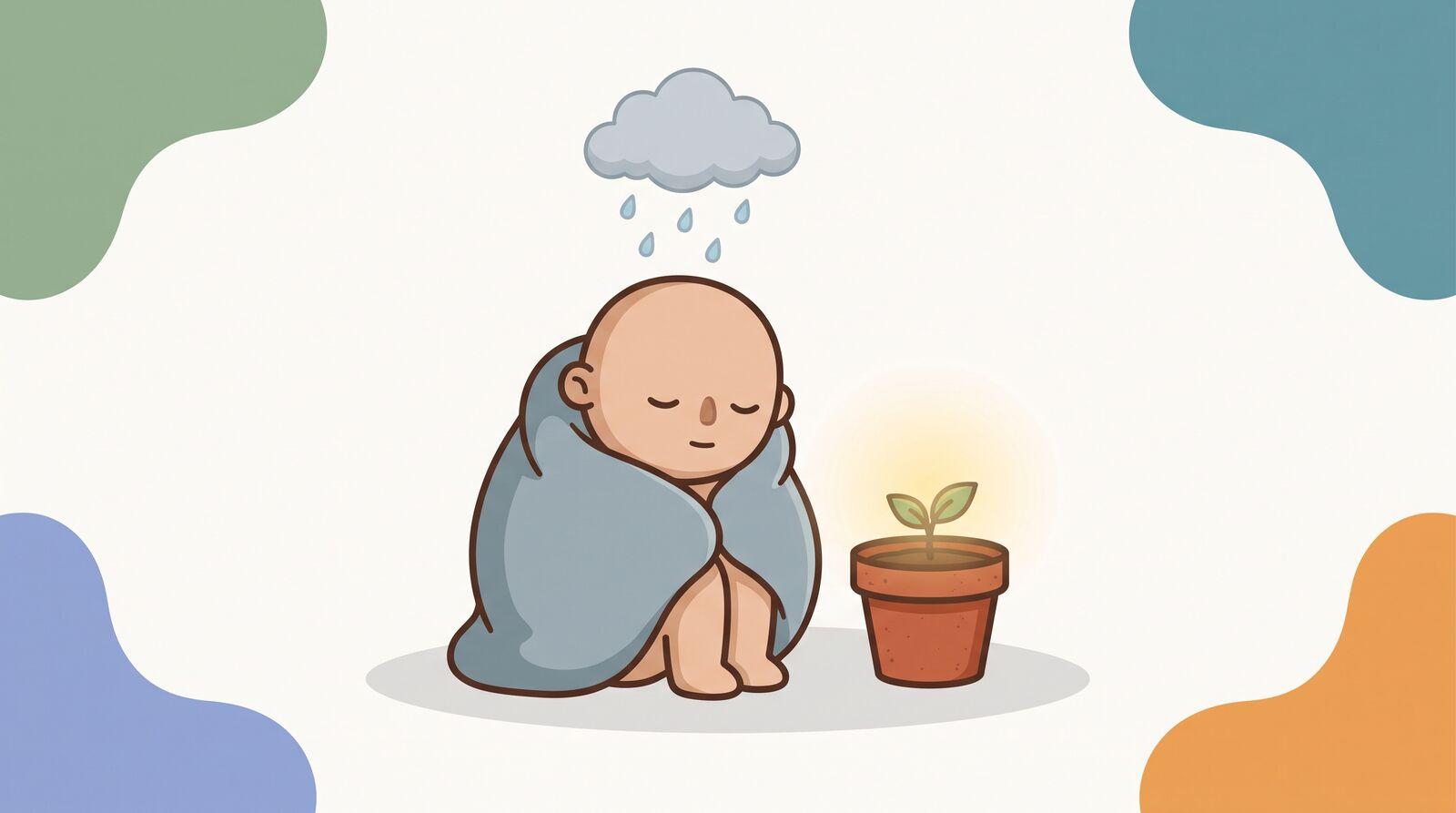
Les envies de fumer, vous vous y attendiez. L'irritabilité, on vous avait prévenu. Ce à quoi personne ne vous a préparé, c'est le gris. Une semaine après l'arrêt, rien ne va vraiment mal, et rien ne va vraiment bien non plus. La musique ressemble à du bruit. La nourriture a le goût du carburant. Les choses que vous attendez habituellement avec plaisir arrivent et ne provoquent rien. Vous n'êtes pas en crise, vous êtes simplement éteint, et une petite voix ne cesse de faire remarquer que vous n'étiez pas éteint quand vous fumiez.
Cette voix défend une thèse, et cette thèse est fausse. Mais elle est assez convaincante pour que l'humeur basse soit l'une des raisons les plus fréquentes d'abandonner un arrêt durant le premier mois, souvent en se disant qu'on le fait pour sa santé mentale. Cet article explique ce qui se passe réellement dans votre cerveau, combien de temps cela dure, comment distinguer une dysphorie de sevrage normale d'un épisode dépressif qui nécessite un traitement, et pourquoi les données à long terme pointent si fermement dans la direction opposée à ce que vous fait ressentir la deuxième semaine.
Est-il normal de se sentir déprimé après avoir arrêté de fumer ?
Oui, et c'est assez normal pour être inscrit dans les manuels diagnostiques. L'humeur dépressive fait partie des symptômes formellement validés du sevrage nicotinique, listée dans le DSM-5 aux côtés de l'irritabilité, de l'anxiété, de l'agitation, des difficultés de concentration, de l'augmentation de l'appétit et de l'insomnie. Ce n'est pas une réaction marginale ni le signe d'une motivation défaillante. C'est une caractéristique documentée et attendue des premières semaines.
Les chercheurs qui ont suivi de près des personnes tout au long de leur abstinence retrouvent toujours la même courbe : l'humeur baisse dès le premier ou le deuxième jour, s'enfonce au cours de la première semaine, puis remonte. Dans la revue de référence sur les symptômes de sevrage réellement causés par l'arrêt du tabac, l'humeur dépressive passe le test sans difficulté, avec une évolution d'environ deux à quatre semaines chez la plupart des gens.
Ce qui la rend plus déroutante que les autres symptômes, c'est qu'elle ne s'annonce pas comme un sevrage. Une envie de fumer est manifestement une envie de fumer. Une insomnie est manifestement une insomnie. Mais la platitude, elle, ressemble à une information sur votre vie plutôt qu'à l'effet secondaire d'un calendrier chimique, et c'est exactement pour cela qu'elle met si efficacement fin aux tentatives d'arrêt. Notre chronologie du sevrage jour par jour situe ce symptôme par rapport à tout le reste de ce que vous ressentez.
Pourquoi le sevrage nicotinique éteint votre humeur
Deux mécanismes distincts se combinent ici, et presque tous les articles n'en couvrent qu'un seul.
Mécanisme un : la baisse de la régulation dopaminergique. La nicotine atteint votre cerveau environ dix secondes après l'inhalation et déclenche une libération de dopamine dans le circuit de la récompense. Faites cela vingt fois par jour pendant des années et le cerveau s'adapte, comme il le fait toujours face à un signal externe répété : il multiplie les récepteurs nicotiniques et réduit sa propre signalisation dopaminergique de base pour compenser cet apport artificiel constant. Le système atteint un nouvel équilibre qui dépend de la présence du produit. Retirez le produit et les compensations restent en place : pendant quelques semaines, vous fonctionnez donc avec un circuit de la récompense réglé pour un apport de dopamine qui n'arrive plus. Subjectivement, c'est l'anhédonie : cette expérience précise et déstabilisante où plus rien ne fait vraiment d'effet. Nous détaillons la remise à zéro plus large du circuit de la récompense dans notre article sur le reset dopaminergique après l'arrêt.
Mécanisme deux : l'effet sur la monoamine oxydase, qui n'a rien à voir avec la nicotine. C'est la partie dont presque personne n'a entendu parler, et elle explique pourquoi arrêter de fumer frappe l'humeur plus fort qu'arrêter la nicotine seule. La fumée de cigarette contient des composés, distincts de la nicotine, qui inhibent la monoamine oxydase, l'enzyme chargée de dégrader la dopamine, la sérotonine et la noradrénaline. Des travaux d'imagerie cérébrale ont montré que les fumeurs ont une activité de la monoamine oxydase réduite d'environ 30 à 40 pour cent par rapport aux non-fumeurs. Concrètement, fumer agissait comme un inhibiteur de MAO faible et non régulé, une classe de médicaments par ailleurs utilisée pour traiter la dépression. Quand vous arrêtez, cette activité enzymatique revient à la normale en quelques semaines, et vos neurotransmetteurs recommencent à être éliminés à un rythme normal après des années d'élimination ralentie.
Donc l'humeur basse n'est ni imaginaire ni un manque de volonté. Vous avez supprimé un stimulant, une béquille du circuit de la récompense et un antidépresseur accidentel le même matin. Quelques semaines de platitude sont une réponse proportionnée et, surtout, temporaire : les deux mécanismes s'inversent.
La chronologie de la dépression après l'arrêt
Connaître la courbe a un intérêt : elle transforme un ressenti sans fin en un ressenti borné, et c'est surtout l'absence de fin qui rend la chose insupportable.
Jours 1 à 3 : la chute. La nicotine quitte votre organisme en environ 72 heures. L'humeur baisse en même temps que montent l'irritabilité et l'agitation, souvent avec une lourdeur et une absence d'élan. Le sommeil est en général déjà perturbé, ce qui amplifie tout le reste.
Jours 3 à 10 : le creux. C'est la période la plus dure pour la plupart des gens et elle coïncide avec le pic des envies, ce qui explique la réputation de la première semaine sans tabac. L'anhédonie est ici à son maximum. Les matins sont souvent les pires, en partie parce que le manque accumulé pendant la nuit a toujours été le plus marqué, un schéma que nous détaillons dans notre article sur l'anxiété matinale chez les fumeurs.
Semaines 2 à 4 : la remontée. L'humeur s'améliore nettement mais de façon irrégulière, par à-coups plutôt qu'en ligne droite. L'énergie revient avant le plaisir. La plupart des gens ont dépassé le plus dur des symptômes d'humeur à la fin de la quatrième semaine.
Semaines 4 à 12 : le plaisir se rallume. L'anhédonie est le symptôme le plus lent à se résoudre parce qu'elle dépend de la normalisation réelle de la densité des récepteurs et de la sensibilité dopaminergique, et pas seulement de l'élimination de la nicotine. Les études d'imagerie montrent que le nombre élevé de récepteurs créé par le tabagisme revient vers les niveaux des non-fumeurs en quelques semaines à quelques mois. C'est la période où les gens rapportent que la musique, la nourriture, l'humour et la compagnie recommencent progressivement à faire de l'effet. Notre article sur la récupération du cerveau après l'arrêt explique ce qui se passe structurellement pendant cette fenêtre.
À partir du 3e mois : le bilan devient positif. Au-delà de la période de sevrage, la tendance s'inverse complètement, ce qui fait l'objet de la section ci-dessous.
Pourquoi la cigarette donnait l'impression d'un antidépresseur, sans en être un
Presque tous les fumeurs ont fait l'expérience d'une cigarette qui remonte le moral, et cette expérience est réelle. C'est l'interprétation qui dérape.
Un fumeur n'est jamais à un niveau de base neutre. La demi-vie de la nicotine est d'environ deux heures : un léger sevrage s'installe donc dans l'heure ou les deux heures qui suivent la dernière cigarette, un fond irritable, terne et sans joie que la plupart des fumeurs cessent de percevoir consciemment, parce que c'est simplement ce qu'ils ressentent entre deux cigarettes. La cigarette suivante supprime ce sevrage et les ramène à la normale. On a l'impression d'être élevé au-dessus du niveau de base. On y est seulement ramené.
C'est pour cela que le soulagement est si convaincant et si trompeur. Sur une journée, un fumeur de vingt cigarettes traverse vingt petits sevrages et vingt petits sauvetages, attribue les sauvetages à la cigarette et ne lui attribue jamais les sevrages. Le produit crée le problème qu'il résout ensuite, à peu près une fois par heure, pendant des décennies.
Quand vous arrêtez, vous vivez le sevrage sans le sauvetage, et l'esprit tire la conclusion évidente mais fausse : les cigarettes soutenaient mon humeur. Ce qui s'est réellement passé, c'est que vous avez cessé de payer un péage horaire et que vous êtes maintenant dans le règlement unique du compte, étalé sur plusieurs semaines. Notre article sur ce que l'arrêt fait à la santé mentale retrace la même illusion du côté de l'anxiété et du stress.
Ce qui aide vraiment
La dysphorie de sevrage se résout d'elle-même : l'objectif n'est donc pas de la vaincre mais de soutenir le recalibrage et d'éviter ce qui l'aggrave.
Faites l'activité avant d'en avoir envie. L'approche la mieux étayée face à l'anhédonie est l'activation comportementale : planifier délibérément des activités gratifiantes, utiles ou sociales et les faire indépendamment de la motivation, plutôt que d'attendre que l'envie revienne d'abord. Cela semble à l'envers, parce qu'avec un circuit de la récompense qui fonctionne, l'envie précède normalement l'action. Avec un circuit temporairement émoussé, l'ordre s'inverse : l'action vient d'abord et l'étincelle de plaisir la suit, faiblement au début puis plus nettement. Attendre d'en avoir envie est le piège, puisque le symptôme lui-même consiste précisément à ne pas en avoir envie.
Utilisez l'exercice comme un médicament, pas comme une corvée. L'exercice aérobie réduit mesurablement les symptômes dépressifs par lui-même et réduit indépendamment les envies de fumer, ce qui en fait l'intervention isolée la plus rentable dans cette fenêtre précise. Nul besoin d'être ambitieux : une marche rapide de 20 à 30 minutes par jour suffit à faire la différence. Notre guide sur l'exercice pendant le sevrage explique comment démarrer sans en faire trop.
Protégez votre sommeil avec rigueur. La perturbation du sommeil est le principal amplificateur de l'humeur basse durant les premières semaines, et l'arrêt perturbe le sommeil de façon fiable. Une heure de lever fixe, une chambre sombre et fraîche, et pas de caféine après le début d'après-midi feront plus pour votre humeur que n'importe quelle quantité d'introspection. Notre article sur l'insomnie après l'arrêt explique pourquoi elle est temporaire.
Gérez les pics pour qu'ils n'aggravent pas la platitude. L'humeur basse du sevrage arrive rarement seule : elle est le plus souvent tressée avec de l'anxiété et de l'agitation, et un pic aigu laisse un résidu qui rend le niveau de base encore plus pénible. Une respiration lente à environ six cycles par minute pendant deux à trois minutes fait redescendre un pic aigu en 90 secondes environ, en agissant sur le système nerveux autonome plutôt que sur ce que vous pensez de la situation. Notre application compagnon Flow Breath est conçue exactement pour ces moments courts et situationnels, et s'accorde bien avec les premières semaines d'un arrêt. Le versant anxieux du sevrage est traité en détail à part.
Ne traversez pas ça seul et en silence. Dites à quelqu'un ce qui se passe et pourquoi, idéalement avant que cela commence. Un conjoint qui sait que la deuxième semaine est chimiquement rude lira votre platitude correctement plutôt que personnellement, ce qui vous évite un second problème dont vous n'avez pas besoin.
Parlez traitement si vous avez des antécédents dépressifs. Le bupropion, l'un des deux médicaments de première intention pour l'arrêt du tabac, est un antidépresseur à part entière, ce qui peut en faire un choix naturel si l'humeur est votre principal facteur de risque. Le grand essai EAGLES, qui incluait spécifiquement des personnes atteintes de troubles psychiatriques, n'a trouvé aucune augmentation significative des événements neuropsychiatriques graves avec le bupropion ou la varénicline par rapport au placebo ou aux patchs nicotiniques, et la FDA a retiré l'avertissement encadré des deux en 2016. Notre panorama des médicaments pour arrêter de fumer détaille les compromis, et c'est une conversation à avoir avec un médecin plutôt qu'une décision à prendre à partir d'un article.
Quand ce n'est plus seulement du sevrage
La plupart des humeurs basses après l'arrêt relèvent du sevrage et se dissipent. Certaines non, et le coût d'une erreur, prendre un véritable épisode dépressif pour « juste du sevrage », est élevé. Utilisez la direction et le contenu comme vos deux tests.
La direction. La dysphorie de sevrage s'améliore semaine après semaine, de façon irrégulière mais indiscutable, et elle répond au moins partiellement au mouvement, au sommeil et à l'activité. Une humeur qui continue de s'enfoncer à la troisième semaine, ou qui ne s'est pas nettement relevée à la sixième, ne suit pas le schéma du sevrage.
La direction est aussi la chose la plus difficile à juger de l'intérieur, parce que l'humeur basse réécrit discrètement votre souvenir de la semaine précédente et vous rapporte que rien n'a changé. C'est l'une des rares situations où un point quotidien à un seul chiffre mérite vraiment sa place : notre application compagnon AnxietyPulse enregistre l'humeur, l'anxiété et les déclencheurs en une trentaine de secondes par jour et garde tout sur votre appareil, ce qui transforme une vague impression de « ça ne va pas mieux » en une courbe que vous pouvez réellement regarder. Cela vous donne aussi quelque chose de concret à montrer à un médecin, au lieu d'essayer de reconstituer six semaines de mémoire en dix minutes de consultation.
Le contenu. Le sevrage vous rend éteint, irritable et sans joie. La dépression clinique y ajoute quelque chose de qualitativement différent : un sentiment persistant d'inutilité ou de culpabilité, l'impression que c'est définitif et mérité, une perte de fonctionnement au travail ou à la maison, des troubles sévères de l'appétit ou du sommeil qui ne s'améliorent pas et, dans les cas les plus graves, des pensées d'automutilation.
Contactez un médecin si le tableau correspond à cette seconde description, et contactez un médecin, une ligne d'écoute d'urgence ou les services d'urgence immédiatement, pas après le week-end, si vous avez des pensées de vous faire du mal. Ce n'est pas un échec de l'arrêt et cela ne veut pas dire que vous devriez recommencer à fumer. Cela veut dire qu'une pathologie traitable, que les cigarettes masquaient en partie, est désormais visible et peut enfin être correctement prise en charge.
Une dernière chose à savoir : une revue systématique a trouvé que les tentatives d'arrêt qui échouent sont elles-mêmes associées à des symptômes dépressifs et anxieux plus marqués. Si vous avez déjà rechuté et vous êtes senti mal ensuite, c'est un schéma documenté et non un verdict personnel, et c'est un argument pour mettre du soutien en place cette fois-ci plutôt que pour ne pas essayer. Notre guide sur que faire après un faux pas explique comment empêcher une cigarette de devenir une rechute complète.
Le bénéfice à long terme est réel et mesurable
Voici le résultat auquel se raccrocher pendant que la deuxième semaine fait de son pire.
Une méta-analyse publiée dans le BMJ a regroupé les études disponibles comparant les personnes ayant réussi à arrêter de fumer à celles qui ont continué, en mesurant l'humeur sur des mois plutôt que sur des jours. Celles qui avaient arrêté présentaient significativement moins de dépression, moins d'anxiété, moins de stress, ainsi qu'une meilleure humeur positive et une meilleure qualité de vie psychologique. L'ampleur de l'amélioration de l'humeur était comparable à ce qu'obtient un traitement antidépresseur pour les troubles de l'humeur. Le bénéfice se maintenait aussi bien chez les personnes ayant des troubles psychiatriques préexistants que chez celles qui n'en avaient pas.
Lisez cela attentivement, car cela inverse complètement la croyance populaire. La population qui finit la moins déprimée n'est pas celle des fumeurs qui ont gardé leur mécanisme d'adaptation. C'est celle des gens qui ont traversé les quatre semaines.
La platitude que vous ressentez en ce moment n'est pas l'avant-goût de votre vie sans tabac. C'est la facture de la précédente.
Comment Smoke Tracker peut-il vous aider à traverser cela ?
L'humeur basse est particulièrement dangereuse pour un arrêt parce qu'elle attaque votre raisonnement et pas seulement votre confort. Les envies vous demandent d'enfreindre une règle à laquelle vous croyez encore. La dépression, elle, argumente discrètement que la règle ne valait rien depuis le début. Le suivi travaille exactement contre cela, parce qu'il garde les preuves sous vos yeux au moment où votre jugement est le moins fiable.
- Chronologie santé : quand rien ne ressemble à un progrès, la chronologie montre les progrès que vous ne pouvez pas sentir. La circulation, la fonction pulmonaire et le risque cardiovasculaire s'améliorent dans les temps, que votre humeur ait rattrapé son retard ou non, et voir cela découplé de votre ressenti est précisément l'intérêt.
- Compteur de série : le creux de l'humeur tombe entre les jours trois et dix, quand la série est encore jeune et que la tentation de renoncer à la tentative est la plus forte. Un chiffre visible transforme la pire période en quelque chose que vous avez déjà payé, plutôt qu'en quelque chose que l'on peut abandonner à la légère.
- Boîte à outils anti-envie : l'humeur plate et les envies s'amplifient mutuellement, et l'idée qu'une cigarette rétablirait votre niveau de base est le mensonge le plus convaincant de la deuxième semaine. Avoir une alternative concrète de deux minutes toute prête compte davantage quand la motivation est basse, pas moins.
- Argent économisé : l'activation comportementale a besoin de choses vers lesquelles s'activer. Dépenser les économies des premières semaines dans quelque chose de précis et d'agréable n'est pas futile, c'est un traitement : une récompense programmée pour un circuit de la récompense qui a besoin de s'entraîner à enregistrer de nouveau les récompenses.
Si vous êtes dans le gris en ce moment, la chose la plus utile à savoir est que cela a une date de fin et que cette date est proche. Votre circuit de la récompense n'est pas cassé, il se recalibre après une décennie d'apport artificiel, et il termine le travail tout seul en quelques semaines, que vous y croyiez ou non. La version de vous de l'autre côté est mesurablement moins anxieuse, moins stressée et moins déprimée que celle qui fumait encore.
L'humeur basse après l'arrêt est un symptôme de sevrage avec une chronologie, pas un verdict sur votre vie. Elle culmine dans les dix premiers jours, se dissipe en deux à quatre semaines, et laisse place à un niveau d'humeur meilleur que celui auquel les cigarettes vous maintenaient. Bougez, préservez votre sommeil, faites les choses avant d'en avoir envie, et demandez de l'aide si cela s'aggrave au lieu de s'améliorer.
Sources
- Taylor, G., McNeill, A., Girling, A., et al. (2014). "Change in mental health after smoking cessation: systematic review and meta-analysis." BMJ. pubmed.ncbi.nlm.nih.gov
- Hughes, J. R. (2007). "Effects of abstinence from tobacco: valid symptoms and time course." Nicotine & Tobacco Research. pubmed.ncbi.nlm.nih.gov
- Fowler, J. S., Volkow, N. D., Wang, G. J., et al. (1996). "Inhibition of monoamine oxidase B in the brains of smokers." Nature. pubmed.ncbi.nlm.nih.gov
- Anthenelli, R. M., Benowitz, N. L., West, R., et al. (2016). "Neuropsychiatric safety and efficacy of varenicline, bupropion, and nicotine patch in smokers with and without psychiatric disorders (EAGLES): a randomised, double-blind, triple-dummy, placebo-controlled clinical trial." The Lancet. pubmed.ncbi.nlm.nih.gov
- Benowitz, N. L. (2010). "Nicotine addiction." New England Journal of Medicine. pubmed.ncbi.nlm.nih.gov
- American Psychiatric Association. (2013). "Diagnostic and Statistical Manual of Mental Disorders, Fifth Edition: Tobacco Withdrawal." psychiatry.org
- National Cancer Institute (smokefree.gov). "Smoking and Depression." smokefree.gov
- Centers for Disease Control and Prevention. "7 Common Withdrawal Symptoms." cdc.gov
Questions fréquentes
- La dépression est-elle un symptôme normal de l'arrêt du tabac ?
- Oui. L'humeur dépressive fait partie des symptômes formellement validés du sevrage nicotinique et figure dans les critères diagnostiques du DSM-5, aux côtés de l'irritabilité, de l'anxiété, des difficultés de concentration, de l'agitation, de l'augmentation de l'appétit et de l'insomnie. Les recherches qui suivent des personnes pendant leurs premières semaines d'abstinence retrouvent systématiquement une baisse mesurable de l'humeur, qui commence dès le premier ou le deuxième jour, culmine durant la première semaine et se résout chez la plupart des gens en deux à quatre semaines. Ce n'est pas le signe que l'arrêt n'est pas fait pour vous, ni la preuve que vous aviez besoin des cigarettes pour votre santé mentale. C'est la conséquence prévisible du retrait d'une substance autour de laquelle votre circuit de la récompense avait construit son niveau de base. Ce qui compte, c'est le sens de l'évolution : l'humeur basse liée au sevrage s'améliore semaine après semaine, un épisode dépressif non.
- Combien de temps dure la dépression après l'arrêt du tabac ?
- Pour la grande majorité des gens, l'humeur basse après l'arrêt suit une courbe nette. Elle commence dans les 24 à 72 premières heures, à mesure que la nicotine est éliminée, s'accentue entre les jours trois et dix environ, puis s'allège sensiblement au fil des semaines deux et trois, et est largement résolue à la fin de la quatrième semaine. L'anhédonie, ce symptôme précis où ce qui vous procure normalement du plaisir cesse simplement de faire de l'effet, traîne souvent un peu derrière les autres symptômes et peut mettre six à huit semaines à disparaître complètement, parce qu'elle dépend de la reconstruction de la sensibilité du circuit de la récompense et pas seulement de la disparition de la nicotine dans le sang. Les études d'imagerie cérébrale montrent que la densité élevée de récepteurs nicotiniques créée par le tabagisme revient vers les niveaux des non-fumeurs sur une période de quelques semaines à quelques mois, ce qui correspond à la chronologie subjective rapportée par les gens. Tout ce qui continue de s'aggraver après quatre semaines est sorti du schéma normal du sevrage et mérite une évaluation médicale.
- L'arrêt du tabac provoque-t-il la dépression, ou ne fait-il que la révéler ?
- Les deux se produisent, et il est important de les distinguer. L'arrêt provoque réellement une baisse temporaire de l'humeur par le sevrage, et cette baisse est spontanément résolutive. Mais fumer fonctionne aussi comme une automédication non reconnue chez un nombre important de personnes : les taux de tabagisme sont bien plus élevés chez les personnes dépressives, et les cigarettes fournissaient un effet dopaminergique et anti-monoamine oxydase grossier qui masquait en partie un trouble de l'humeur sous-jacent. Quand cela disparaît, ce qui remonte à la surface n'est pas nouveau, c'était là en dessous. Ce n'est pas une raison de continuer à fumer. C'est une raison d'arrêter avec un accompagnement en place, parce que la pathologie sous-jacente se traite par des moyens bien plus efficaces et bien moins destructeurs que les cigarettes. Si vous avez des antécédents de dépression, parlez-en à votre médecin avant votre date d'arrêt, pour que les deux choses soient prises en charge ensemble plutôt que l'une après l'autre.
- Serai-je plus heureux à long terme si j'arrête de fumer ?
- Les données sur ce point sont inhabituellement solides et pointent clairement dans une seule direction. Une grande méta-analyse publiée dans le BMJ a regroupé les études comparant les personnes qui ont arrêté de fumer à celles qui ont continué, et a trouvé que celles qui avaient arrêté présentaient des niveaux significativement plus bas de dépression, d'anxiété et de stress, ainsi qu'une meilleure humeur positive et une meilleure qualité de vie psychologique. L'ampleur de l'effet sur l'humeur était comparable à ce qu'obtient un traitement antidépresseur. Cela restait vrai chez les personnes avec et sans troubles psychiatriques préexistants. La croyance courante selon laquelle fumer soutient la santé mentale inverse la causalité : le soulagement qu'apporte une cigarette n'est que la fin du sevrage créé par la cigarette précédente, si bien qu'un fumeur traverse un léger sevrage des dizaines de fois par jour. C'est la suppression de ce cycle qui produit l'amélioration à long terme, mais il faut d'abord traverser les deux à quatre semaines de recalibrage pour y arriver.
- Quand faut-il consulter un médecin pour une humeur basse après l'arrêt ?
- Consultez si l'un des éléments suivants s'applique : votre humeur continue de se dégrader au lieu de s'améliorer après deux à trois semaines, l'humeur basse persiste au-delà de quatre à six semaines, vous vous sentez durablement sans valeur ou coupable plutôt que simplement éteint, vous n'arrivez plus à fonctionner au travail ou à la maison, votre sommeil et votre appétit sont sévèrement perturbés sans amélioration, ou vous avez des pensées de vous faire du mal. Les pensées d'automutilation sont une raison immédiate de contacter un médecin, une ligne d'écoute d'urgence ou les services d'urgence, ce n'est pas quelque chose qu'il faut laisser passer. Si vous avez des antécédents personnels ou familiaux de dépression, organisez un accompagnement avant votre date d'arrêt plutôt qu'une fois les symptômes apparus. Le bupropion, l'un des deux principaux médicaments d'aide à l'arrêt, est lui-même un antidépresseur et peut être particulièrement adapté dans cette situation : une conversation à avoir avec votre médecin à l'avance.
Cet article est fourni à titre informatif uniquement et ne constitue pas un avis médical. Les informations de santé sont basées sur des recherches publiées par des organisations telles que le CDC, l'WHO et l'American Lung Association. Consultez toujours un professionnel de santé pour des conseils personnalisés sur le sevrage tabagique.