If you have ever checked your blood pressure right after a cigarette, you may have seen a number that surprised you. That is not a glitch. Smoking and blood pressure are linked in a more immediate, mechanical way than most people realize, and the link runs in your favor the moment you quit. The honest answer to "does quitting lower my blood pressure" is yes, but the useful version of that answer separates two very different timescales: what happens in the next twenty minutes, and what happens over the next twenty years. Both move in the right direction once you stop.
Does Smoking Actually Raise Blood Pressure?
It does, and there is a subtlety worth getting right because it trips up a lot of people. There are two separate effects, working on different clocks.
The first is acute: every single cigarette spikes your blood pressure. Within minutes of lighting up, nicotine drives a surge of adrenaline that tightens your blood vessels and speeds your heart, pushing systolic pressure up by roughly 5 to 10 mmHg for about 15 to 20 minutes. A pack-a-day smoker triggers that spike fifteen to twenty times a day, spending a large share of waking hours with elevated pressure and a faster resting heart rate.
The second is chronic and slower. Here the data is genuinely nuanced: smoking is not listed as a classic cause of sustained hypertension the way excess salt or obesity is, and there is a well-documented quirk where heavy smokers sometimes post slightly lower readings in the clinic. But their 24-hour ambulatory pressure tends to run higher, and, far more importantly, smoking relentlessly stiffens artery walls and accelerates atherosclerosis, the plaque buildup that narrows vessels. That combination is why smoking plus high blood pressure is so much more dangerous than either alone: the two multiply each other's damage to your heart and brain.
What Nicotine Does to Your Arteries in Real Time
Picture the twenty minutes after a cigarette. Nicotine reaches your brain in seconds and tells your adrenal glands to release catecholamines, your fight-or-flight hormones. Those hormones do three things at once: your heart beats faster, the muscle in your artery walls contracts so the vessels narrow, and the resistance your heart pumps against rises. The result is a measurable jump in both heart rate and blood pressure, a small cardiovascular sprint you never asked for.
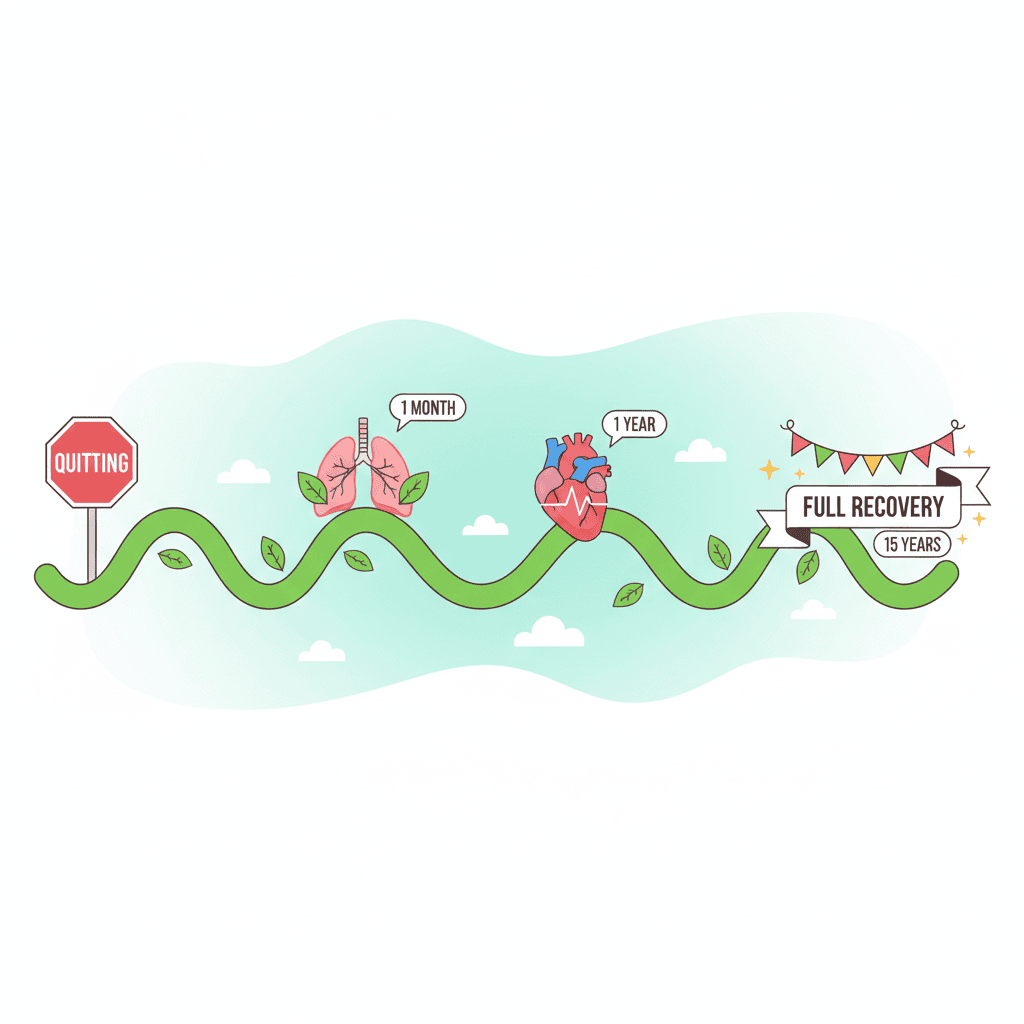
Meanwhile the carbon monoxide in smoke binds to your red blood cells in place of oxygen, so your heart has to work harder to deliver less. Repeated thousands of times, this is the daily grind that wears arteries down. The encouraging flip side is that the acute part is almost entirely reversible on a short clock: stop feeding your system nicotine and the spikes simply stop arriving. This is the same recovery cascade covered in the full heart recovery timeline, where circulation and resting pulse improve in the weeks after your last cigarette.
What Happens to Your Blood Pressure When You Quit
The recovery follows a predictable shape, and it starts faster than almost any other quit-smoking benefit.
- Within 20 minutes: The acute nicotine effect begins to fade. Your heart rate and blood pressure start dropping back toward your personal baseline. This is the famous "20-minute" milestone, and it is real.
- Within 24 hours: Blood nicotine and carbon monoxide levels fall sharply, easing the immediate load on your heart and improving how much oxygen your blood can carry.
- Weeks 2 to 12: As nicotine fully clears from your system and your vessels stop being constricted dozens of times a day, resting heart rate and average blood pressure settle measurably lower for most people. Circulation noticeably improves.
- Months to years: Arterial stiffness eases and the progression of plaque slows. By one year, the excess risk of coronary heart disease has dropped to about half that of a continuing smoker, and it keeps falling from there.
The day-to-day numbers and the long-term risk move together: you feel the resting-pulse change within weeks, while the deeper protection of your arteries builds quietly underneath. The complete picture of these overlapping recovery tracks lives in the day-by-day quit-smoking timeline.
The Weight-Gain Caveat (and Why the Net Is Still a Big Win)
Two things can briefly push your readings up after you quit, and it helps to expect them so you do not misread them as a reason to go back.
The first is withdrawal stress. In the first days to weeks, irritability and a jumpier nervous system can raise adrenaline and temporarily nudge blood pressure higher before it settles. The second is weight gain: as appetite returns and metabolism adjusts, many people add a few pounds, and added weight can modestly raise blood pressure over the following months.
Neither overturns the math. The repeated daily nicotine spikes you have eliminated, fifteen to twenty per day for a pack-a-day smoker, vastly outweigh a small, manageable weight effect. And both caveats respond to the same habits that help your pressure anyway: regular movement, sane portions, and calming your nervous system without a cigarette. If post-quit appetite is your main worry, the dedicated guide on weight after quitting breaks down why it happens and how to stay ahead of it.
How to Lower Your Blood Pressure Faster After Quitting
A few levers genuinely speed the recovery, and most of them double as craving tools.
- Breathe slowly and deliberately, especially during cravings. Paced breathing at around six breaths per minute activates the parasympathetic "rest" branch of your nervous system, the exact opposite of the adrenaline surge a cigarette caused. It lowers heart rate and pressure in minutes, with none of the rebound. This is why a breathing reset is the ideal thing to do when an urge or a stressful moment hits; our companion app Flow Breath is built for those 90-second resets and gives your hands and lungs a job while the craving passes.
- Move daily. Even brisk walking lowers resting blood pressure over weeks and burns off the restless, keyed-up energy of early withdrawal. See the exercise and quitting guide for how to start without overdoing it.
- Cut back where smoking and pressure overlapped. Heavy alcohol and high salt both raise blood pressure, and alcohol is also one of the strongest smoking triggers. Easing off both early does double duty.
- Defuse stress without nicotine. Much of what a cigarette seemed to calm was simply the withdrawal it created. Building a few real stress tools that do not involve nicotine keeps your pressure down and your quit intact at the same time.
If you have diagnosed hypertension, keep taking any medication your doctor prescribed and keep your check-ups; quitting is a powerful addition to treatment, not a replacement for it.
How Can Smoke Tracker Help?
The trouble with blood-pressure recovery is that it is invisible. You cannot feel your arteries un-stiffening, and a single reading on a single day tells you almost nothing. Smoke Tracker turns that invisible progress into something you can actually watch.
- Health Timeline: The 20-minute, 24-hour, and 2-to-12-week milestones in this article become live markers that tick over as your smoke-free time accumulates, so the recovery stops being abstract and becomes yours.
- Craving Log: Each logged craving is also a blood-pressure spike you did not trigger. Watching them thin out week by week is direct proof your cardiovascular load is dropping.
- Streak Counter: Passing day 1, day 14, and the one-month mark lines up with the exact windows when resting heart rate and pressure settle, turning the science into banked, visible wins.
- Money Saved: A second number that climbs alongside your health gains, a reminder that every cigarette skipped is one less spike and a little more in your pocket.
Quitting lowers your blood pressure on two clocks at once: the surges stop within the hour, and the slow corrosion of your arteries stops within the weeks and months that follow. You will not feel the moment your heart starts working less hard, but it starts about twenty minutes after your last cigarette, and it keeps getting easier on your heart every day you stay smoke-free.
Sources
- U.S. Department of Health and Human Services. (2010). "How Tobacco Smoke Causes Disease: The Biology and Behavioral Basis for Smoking-Attributable Disease." ncbi.nlm.nih.gov
- Omvik, P. (1996). "How smoking affects blood pressure." Blood Pressure. pubmed.ncbi.nlm.nih.gov
- Groppelli, A., et al. (1992). "Persistent blood pressure increase induced by heavy smoking." Journal of Hypertension. pubmed.ncbi.nlm.nih.gov
- Benowitz, N. L. (2003). "Cigarette smoking and cardiovascular disease: pathophysiology and implications for treatment." Progress in Cardiovascular Diseases. pubmed.ncbi.nlm.nih.gov
- American Heart Association. (2024). "How Smoking and Nicotine Damage Your Body." heart.org
- U.S. Department of Health and Human Services. (2020). "Smoking Cessation: A Report of the Surgeon General." ncbi.nlm.nih.gov
- Aune, D., et al. (2018). "Tobacco smoking and the risk of atrial fibrillation: a systematic review and meta-analysis." European Journal of Preventive Cardiology. pubmed.ncbi.nlm.nih.gov
Common questions
- Does smoking raise your blood pressure?
- Yes, in two distinct ways. The clearest is acute: nicotine triggers a surge of adrenaline that constricts your blood vessels and speeds your heart, pushing systolic pressure up by roughly 5 to 10 mmHg for about 15 to 20 minutes after each cigarette. A pack-a-day smoker repeats that spike fifteen to twenty times a day. The second is chronic and longer-term: smoking stiffens and damages artery walls and accelerates the plaque buildup of atherosclerosis, which raises cardiovascular risk and contributes to sustained high blood pressure over years. There is a well-known quirk in the data, that smokers can sometimes show lower clinic readings, but their 24-hour ambulatory pressure tends to run higher, and their overall heart-disease and stroke risk is far greater.
- How long after quitting smoking does blood pressure drop?
- The drop starts fast. Within about 20 minutes of your last cigarette, the acute nicotine effect begins wearing off and your heart rate and blood pressure start returning toward your personal baseline. Within 24 hours the blood level of nicotine and carbon monoxide has fallen sharply, easing the load on your heart. Over the following 2 to 12 weeks, as nicotine fully clears and your blood vessels are no longer constricted dozens of times a day, your resting heart rate and average blood pressure settle measurably lower for most people. The deeper improvement, reduced arterial stiffness and slowed plaque progression, unfolds over months to years.
- Can quitting smoking cure high blood pressure?
- Not by itself, in most cases. Smoking is rarely the sole cause of established hypertension, so quitting alone will not always return a diagnosed case to normal, especially when weight, salt, alcohol, genetics, or kidney factors are also driving it. What quitting does is remove a major aggravating force: it stops the repeated daily spikes, lowers resting numbers somewhat, and, most importantly, dramatically cuts the risk of the heart attacks and strokes that high blood pressure and smoking cause together. If you have hypertension, quitting is one of the highest-impact things you can do, but keep taking any prescribed medication and keep working with your doctor on the other levers.
- Why did my blood pressure go up after I quit smoking?
- A short-term rise can happen for two ordinary reasons, and neither means quitting was a mistake. First, nicotine withdrawal raises stress, irritability, and adrenaline in the first days to weeks, which can temporarily push readings up before they settle. Second, many people gain some weight after quitting as appetite returns and metabolism adjusts, and added weight can modestly raise blood pressure over the following months. Both are manageable: the withdrawal-driven bump fades as your nervous system recalibrates, and the weight effect responds to the same diet and activity steps that help anyone. The repeated daily nicotine spikes you have eliminated outweigh these by a wide margin.
- Is nicotine or the smoke worse for blood pressure?
- For blood pressure specifically, nicotine is the main acute driver: it is the chemical that triggers the adrenaline surge, vessel constriction, and heart-rate jump behind each post-cigarette spike. That is why nicotine from any source, vapes, pouches, gum, or patches, also raises blood pressure acutely, though replacement therapy delivers it more slowly and steadily than a cigarette. The smoke matters more for the long game: carbon monoxide and the thousands of combustion toxins are what corrode artery walls, accelerate atherosclerosis, and drive the heart-attack and stroke risk. Quitting nicotine entirely is the goal, but moving off combustible smoke removes the larger long-term threat to your arteries.
This article is for informational purposes only and does not constitute medical advice. Health information is based on published research from organizations such as the CDC, WHO, and American Lung Association. Always consult a healthcare professional for personalized guidance on smoking cessation.